A report on Channelnewsasia.com describes residents unease when they received election pamphlets by mail that displayed their NRIC (National Registration Identity Code) on the mailing label.
The article quotes the Elections Department:
"In response to Channel NewsAsia, the Elections Department says the NRIC numbers are given out to political parties as an assurance that the electors are genuine persons.
The Registers of Electors may be purchased by political parties and aspiring candidates to facilitate their communication with registered electors."
Which is nonsense of course. The Elections Department has to know that a voter is genuine, but having done so, there is no reason to further distribute sensitive information such as the NRIC to third parties. This lack of awareness of basic security is breath-taking, particularly given the very public and ongoing problem of identity theft.
Anyone who believes that national ID cards are a benign move permitting good government needs to realize that once a number is established, the genie is out of the bottle.
It is routine for security guards at buildings in Singapore to demand physical possession of your NRIC card before permitting entry to a building. Which makes it somewhat difficult to prove one's identity while inside the building, and leaves a nagging sense of peril that the guard is using your NRIC card for some other nefarious purpose, but hey, that's security.
Identity Theft
Singapore
Elections
Tuesday, May 02, 2006
Singapore Elections - We Really Know Who You Are


Monday, May 01, 2006
Singapore Elections - We Know Who You Are
The Today newspaper carried an article on April 22, 2006 entitled "Be ready for checks at rallies" which describes new rules apparently permitting the police to conduct physical checks on people attending political rallies.
I attempted to find the rules, or the press statement that Today is quoting from, on the Singapore Police web site, under Media Releases, but it does not appear to be there. Further digging turned up something called the Police Elections Liaison Office, with a web site here. The actual document is in .pdf format here.
One wonders how the average citizen is supposed to know about all these rules, or who is making them.
The rationale for allowing police to completely control political rallies and those who attend them was given by Mr. Seng Han Thong of the People's Action Party.
"Election rallies are opportunities for terrorists who want to "sabotage". "These places are more vulnerable and the measures are to ensure that no one can take advantage of such a situation."
Singapore
Elections
Sunday, April 30, 2006
Counting Skype Users
Jeremy Wagstaff has a blog entry entitled "Skype's 100 Million: Where The Hell Are They?" in which he questions Skype's claim of 100 million users. As users of Skype will note, the number of online users at any given moment is somewhere around 6 million.
Not sure what all the angst is about Skype subscriber numbers. Any telecom service is going to have more registered users than online users at any given moment. If not, the networks would collapse, since they are all engineered with a level of over subscription implicit in the design.
Skype is different from a conventional switched network because it is using peer to peer technology, so theoretically, it should be able to scale better.
I am just happy it exists. Having access to cheap, easy to use voice and video communications with chat and presence has completely changed the way I do business and interact with family.
Skype
StarHub - Smart TV Firmware 1.10 update
I was in the middle of trying to send my StarHub DVR back because of the poor performance, when they finally released a new firmware update, 1.10.
Because of family protests about the poor quality, I had already removed the new DVR from our main setup and reverted to the digital cable STB. The DVR now sits with the second TV, and is only occasionally used.
I cannot say at this point whether the new firmware makes any difference. When I went back to using my Pioneer DVR-520H, it was just so clean and simple that any desire to continue fooling around with the StarHub box just evaporated.
Apart from the fact that the Smart TV supposedly allows programmed recording from the on-screen directory, nothing else about it matches up to the quality of the Pioneer. I say supposedly because the previous firmware routinely failed to record selected programs.
I will eventually get around to testing the unit, but for now, it has achieved the status of an enthusiasm that didn't pan out.
StarHub
Singapore Election - No Comments Please
There is an old saying that people get the government they deserve.
It has been a frustrating week watching the PAP machine grind toward the official calling of the Singapore General Election. Frustrating because of the peril one faces if observations or opinions are objected to. I can't truthfully say that the risk is worth it, and so have decided to write privately, rather than post any comments to my blog.
Suffice to say that events here stretch the definition of democracy to an extent that would be unrecognizable to a citizen of ancient Athens, the birth place of rule by the people.
Singapore
Elections
Saturday, April 22, 2006
Singapore Elections - Let the lawsuits begin
The Straits Times is reporting this morning that the Lees, father and son, have issued letters of demand against the Singapore Democratic Party's entire 12 man executive, and the printer of their newsletter.
This is a legal move to accuse the SDP of libel. The leaders of Singapore have used libel law frequently, resulting in the bankruptcy of opposition candidates. Once declared bankrupt, a person cannot run for Parliament.
The specifics of the libel suit relate to statements made in the SDP newsletter which claim the ruling People's Action Party (PAP) leaders have known about, and tolerated, corruption in the NKF charity and other government agencies.
There is a certain repetitious quality to the whole "election, libel suit, huge judgment for the plaintiff, bankruptcy of the candidate" cycle. One wonders why opposition candidates bother to run and/or why they are so careless about opening themselves to libel charges.
Granted, anywhere else commonly thought of as a democracy, most of the statements would be protected free speech.
Elections
Singapore
Tuesday, April 18, 2006
Stealth E-commerce
I have recently had an unpleasant awakening to just how far the concepts of "fair use" and "intellectual property" can be pushed in the wrong direction.
I am an avid reader and collector of books. As the number of volumes has grown, it made sense to use computers and software to organize my collection. I have written before here, and here, about two great ways to accomplish the task.
What bothers me greatly however is that the organizations responsible for the software and service have both chosen to surreptitiously insert their own Amazon affiliate tag into listings and displays.
Let me explain the implications of this. Amazon has a program in which you can sign up to be an affiliate. They provide tools that let you embed links to books on Amazon within your web site, or as the case may be, listings of books on LibraryThing. If a person clicks through the link and buys the book, you are paid a small percentage as an affiliate.
That is all pretty straight forward. The whole web is driven by advertising, and whether it is Google ads or Amazon affiliate tags, it is a logical and above board way of driving sales and paying for the traffic. You would have to have a pretty popular site to generate earnings of a significant amount in any case, so it is not just the money that bothers me.
Where this all breaks down is when software companies and service providers start inserting their affiliate code into my listings and without prior notice. What is even worse is when those organizations refuse to modify their behaviour having been caught.
My current hall of shame includes:
Book Collector, which inserts their affiliate code in HTML extract reports,
LibraryThing, which inserts their affiliate code in displays of user book collections on the web
The morality is pretty hard to defend. Both Book Collector and LibraryThing rely on open API's to get the information and images they need for their services for free from Amazon and libraries.
This is all reminiscent of the ugly happenings at CDDB, in which tens of thousands of people uploaded CD listings to what they thought was a public domain database, only to have it become a commercial enterprise.
e-commerce
Saturday, April 15, 2006
Redemption

In the spirit of Easter, a few thoughts about rebirth.
The Wife watches Oprah, something I only admit to because apparently she has millions of fellow viewers. Inevitably, I end up sitting through the occasional show as circumstances dictate.
The formula seems pretty well developed. Somebody who has totally screwed up their life comes on, then everybody tut tuts about how well they have screwed up their life. This is followed by an uplifting denouement in which all is forgiven, acne is cleared up, and everybody emerges as happy and productive members of society. All accompanied by much demented cheering from white chicks in the audience who are secretly hoping for some freebie to be handed out.
But enough about Oprah. What really intrigues me is the easy way in which the traditional confessional and penance of mainstream religion has been transformed into the stuff of TV shows and pop literature.
Every society needs rules in order to ensure that things keep running and that the weak have a fighting chance against the strong. Morality, unless you really believe in the stone tablets, is the embodiment of the evolution of those rules.
The problem with systems that hold out damnation for sinners is that they fall apart unless the sinner is offered redemption. After all, if I commit a sin and then am eternally damned, I might as well forget about the rules for the rest of my life and just enjoy myself. Confession and penance are a neat way to keep the flock in line by offering the chance to wipe the slate clean. Now, this used to be something that happened privately, and supposedly confidentially, between you and your religious representative/priest/minister/shaman whatever.
Today in America things have become a lot more open and streamlined. Now you can completely screw up, get caught, do time (or not, depending on how much money you have), then go around telling everybody how much you screwed up and bask in their forgiveness and the 15 minutes of fame that go along with it. All pretty painless.
Since lots of money is spent screwing up, and more on the cure, and then even more on the publicity created by the recovery, one has to believe that this has a significant impact on the economy. Instead of worrying about all the American consumers in debt over their heads, just think of all the pending redemption stories out there. The books. The TV shows. The movies. The new charitable foundations.
I wonder if Greenspan took all this into account.
Oprah
Easter
Friday, April 14, 2006
Book Recommendation - Syrup
It has been a rare treat to have had time to do some reading recently. Even more enjoyable has been the serendipitous introduction to two new authors. I reviewed Barry Eisler's work earlier, and now I have had the chance to finish my first read of a book by Max Barry.
He is simply a great writer. I don't know why I had never heard of his work before, but I couldn't put down Syrup from the moment I started reading. I don't want to go through all the plot and ruin the experience of reading it yourself. Rather, I just want to comment on the authentic voice that Max brings to his observations and dialogue. I constantly found myself nodding and agreeing with behaviour, remembering similar experiences and people.
If I was going to use reviewing cliches, then Syrup is a satirical romp through the world of advertising and corporate politics. Actually, it is funny. Very funny. My immediate reaction on finishing was to go and buy everything else he has written.
Get this book.
There have been a couple of other books that have delivered similar feelings of familiarity and mirth. I can recommend Thomas Scoville's Silicon Follies, and Douglas Coupland's Microserfs for excellent takes on life in Silicon Valley.
StarHub - Smart TV Digital Set Top Box Update
It has been a month since I took delivery of StarHub's new Smart TV digital set top box (STB). My original review is here. The experience over that time has not been satisfactory.
Where to start? Perceptible synchronization problems between audio and video. Heavy pixelization and digital artifacts, random picture breakups, complete crashes of the STB on an almost daily basis, failed recordings, inability to fast forward without losing synchronization, perceptible lag when changing channels.
I was astonished to read the positive review that appeared in the Straits Times Digital Life supplement. OK, not astonished, StarHub is a major advertiser of theirs, and the chances of a negative review were exactly zero. But come on.
Seeing other reviews that don't mention problems, I decided to call StarHub and ask to have my box replaced. The tech immediately agreed and scheduled an appointment. When the installer showed up at my flat, he was reluctant to do the swap. His point was that it would make no difference because the problems were not in the hardware. I insisted that the swap take place anyway, and fired up the new box.
Same problems.
Looking at the firmware revision number, 1.6, it is clear that no new release of software has been made in the last 30 days. I don't mind being a beta tester, but there is something wrong with this picture.
I am paying for hardware that doesn't deliver the service for which it is designed. There is no feedback mechanism to communicate with the beta program engineers other than going through normal 1633 customer disservice. Anyone using the box for more than an hour and exercising its functions would see that it was not ready for release.
My question to StarHub is "Why was this product released to customers?"
Singapore
StarHub
Thursday, April 13, 2006
Book Recommendation - John Rain Thrillers by Barry Eisler
One of the pleasures of reading a newspaper such as The Economist (never to be called a magazine we are informed) is the breadth of its coverage. Rather than a narrow focus on things financial, readers are treated to reviews of cultural matters as well. And it is from one of The Economist's recent book reviews that I discovered the work of Barry Eisler.
Mr. Eisler writes good old fashioned thrillers. He has created a character named John Rain, a half-Japanese, half-American killer for hire. With a combination of detailed tradecraft, martial arts, and exhaustive description of locale, one feels completely immersed in the action.
John Rain is not a simple minded psychopathic killer mind you, but the complex result of much that has gone before, as Eisler reveals throughout the books. The psychological debate Rain has with himself lifts the character out of the cartoon category and allows him to stand with his predecessors, most famously James Bond.
Quibbles? Although there is great detail about surveillance and counter-measures, there is far less detail about how all this is funded. Rain just always seems to have cash on hand, regardless of location or time. I would prefer to see the same level of detail Eisler supplies to surveillance applied to exploring the mechanics of moving and accessing funds.
The first two books have Rain involved against foes in Japan and America, and there is considerable ambiguity as to who the bad guys actually are. It is all quite believable. In the third book, Rain Storm, the foe becomes rather cartoonish Arabs, who are of course stupid, evil, and incompetent. The addition of a blue-eyed, blonde(?) Israeli femme-fatale to the mix makes the whole thing very black and white, losing the more interesting exploration of the shades of grey Eisler achieved in his first two outings. One can see this as astute marketing to an American public looking for Arab bashing books after 9/11, but it doesn't do the character any good.
I am looking forward to see if Eisler gets back on track with his fourth book, Killing Rain. It is not available off the shelf in Singapore, so I have put in an order with Acma to get a copy.
Resurrection
I have trouble throwing away gizmos and gadgets that have ceased to function. On one level, there is a sense of waste, a feeling that if I could just figure out what was wrong, or obtain a missing part, all would be well again. On another level, there is the rememberance of the joy that I felt researching, buying, and learning to use the latest "miust have", and the feeling that somehow that could be recaptured if I had the time or knowledge to fix the thing.
My long time favourite PDA, the Psion 5MX, was notoriously fragile. I put up with the expense and the periodic need to service or replace the thring because it was just so brilliant, and I had built my working habits around its capabilities.
It was the final death of my last Psion, and the fact that the company no longer manufactured the model or provided service in Asia that finally persuaded me to transition to the Nokia 9500. Now I really like the 9500, but it doesn't have all the bells and whistles the 5MX did, and I am still reminded of that fact occasionally when I try and do something that is no longer possible on the Nokia.
Which brings me to an odd occurrence yesterday.
It is Spring, and I was doing some cleaning in the Haunt when I came across my drawer of Psion carcasses. Everything from the original Series 3 to a couple of dead LCD screens from various 5MX's. Sitting with pride of place was the last 5MX, which had died suddenly, without warning, and resisted all attempts at revival. I had backups, and managed to retrieve most of what had been on it, all except my agenda which had been a complete diary of appointments going back more than 10 years.
For old time's sake, I popped in a couple of double A batteries and pushed the reset button. Nothing happened, and a phone call came in, so I just left it sitting on my desk. About five minutes later, I picked up the 5MX and prepared to take out the batteries. I popped the screen one last time to check and there was the setup screen in all its glory.
I went through the familiar motions of completing the script, and was dropped to the main screen of a fully functional Psion Series 5MX. No data files because of the hard reset, but otherwise a ready to go PDA.
I won't go back to using it of course, the same problems with fragility and service would remain. But as a reminder of the basic value of optimisim, it sure felt good.
Psion
Nokia 9500
Wednesday, April 12, 2006
Getting Linked To
Was checking my Technorati listing last night and saw that my blog entry on Social Networking had been referenced over on InfoTangle. I guess this stuff actually works, but is it self-referential or self-reverential?
Saturday, April 08, 2006
StarHub gets dissed in Straits Times
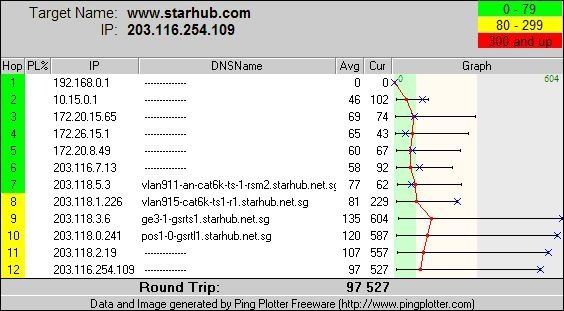
An article appeared in the Friday, April 7, 2006 Straits Times headlined "Gamers upset about StarHub's sluggish broadband speeds".
As a long time subscriber, I can attest to the problem. I can also attest to the lack of any meaningful discussion of the problem. Networks are not mysterious beasts that defy management or description. They are collections of equipment, wires, and configuration instructions. When managed properly, they deliver excellent service in a reliable way.
There seems to be a confusion about the terms speed (capacity), reliability (packet loss), and latency (lag). The discussion with Starhub has degenerated to the "It's slow, no it isn't" level instead of focusing on the very real and measurable problem.
Let's look at the facts. Starhub offers various plans, supposedly with higher speeds for higher prices. However, they do not guarantee any additional bandwidth for traffic after it leaves the local loop connection at a subscriber's home. You may have a high speed circuit, but it is only high speed to the first router within Starhub's network. What happens after that is very much a matter of how badly they oversubscribe their equipment. There is no way that the aggregate bandwidth sold to subscribers is matched one for one in the backbone network of Starhub.
The situation gets even worse when considering overseas sites. Starhub purchases a certain amount of international bandwidth to connect subscribers in Singapore to overseas networks. Again, this bandwidth is oversubscribed at a certain rate, which results in the performance seen by subscribers. There are simple and free tools available on the net such as PingPlotter to graphically show how all these factors come into play to deliver the Internet experience.
What is particularly frustrating is that Starhub refuses to acknowledge subscriber complaints, even when backed up with evidence, and continues to insist that the problem must be at the subscriber end. When that excuse is proven false, they fall back on the minimum service standards published by the IDA.
The bad news for gamers is that the standard is so low for local connections, real time gaming will be barely be acceptable even if StarHub is meeting the standard. The international latency standard of 300msec makes gaming pointless.
One can assess StarHub's approach to the market by looking at how they sell their service. It is not by focusing on the quality, or latency, or reliability. It is by packaging "freebies" with 2 year contracts to lock subscribers in, regardless of the level of service provided. Once you sign the contract or accept the "freebies", you can complain all you want, but you no longer have a choice.
To tell a customer like Mr. Tan, who is already a MaxOnline 6500 subscriber, that he needs a faster service is just ignorant. What he needs is a better network service provider. As do we all.
StarHub
Singapore
Friday, April 07, 2006
CIO Asia Conference and Awards 2006
Attended the CIO Asia Conference and Awards 2006 today. The folks at CIO magazine always put on a good show and this year was no exception. The event was well attended, and the speakers were, for the most part, interesting.
I say for the most part, because there is something that overtakes marketing managers for IT vendors and turns them into blatant shills for their companies. They just don't seem to get the difference between reading Powerpoint presentations to an audience and actually giving some thoughtful insight into the industry or their product sector. Suffice to say, new lows were established.
On a more positive note, any time an end user is prepared to be candid about their operation, I will be in the audience. There was a terrific presentation by Noble Coker, the CIO of Hong Kong Disneyland, and his enthusiasm and insight into his job were a joy to behold.
I was a bit taken aback by a comment from an IT manager at a local health group who explained that it was important for hospital systems to be available 24x7 because otherwise it would get into the papers and the Minister of Health would scold them. I always thought it was because patients would die...
Singapore
Thursday, April 06, 2006
China Agrees to Microsoft Tax
It is being widely reported today that China's main PC manufacturers have agreed to stop shipping machines without a pre-loaded Microsoft operating system.
Supposedly this is to reduce piracy, but in fact it is the U.S. government putting pressure on behalf of Microsoft, which has long licensed its operating system to PC manufacturers based on the number of machines they manufacture. Some of the largest PC manufacturers in China were shipping PC's without any bundled OS.
Under the agreement, regardless of whether a customer wants a PC without an OS, or with an alternative OS such as Linux, the manufacturers end up paying a "tax" to Microsoft for the OS.
This is particularly invidious for large corporate customers who are also forced into bulk contracts with Microsoft. Under programs like Select, a corporate ends up paying twice - once under the Select agreement, and again when it purchases PC's.
Given China's rather visible attempts to avoid paying royalties for foreign IPR (intellectual property rights) for things like DVD's and cell phones, it is surprising that they capitulated on this issue.
Another article indicates that Microsoft is making the same demands on PC manufacturers in the UK.
China
Microsoft
Tuesday, April 04, 2006
Singapore Elections - No Talking
To understand Singapore, it is necessary to understand the statement
"That which is not permitted is forbidden".
Once you take that on board, it is a lot easier to anticipate what might seem like unusual statements by government spokesmen.
One might have thought that a lively debate among an informed electorate was one of the key elements of a healthy democracy, but it turns out that this doesn't apply in Singapore.
The local tabloid Today is carrying an article outlining the government's clarification that podcasting is not allowed during elections, nor is the streaming of video, nor "persistently promoting political views".
------------------------------------------------------------------------------
PODCASTING will not be allowed during elections as it does not fall under the "positive list" which states what is allowed under election advertising.
Dr Balaji Sadasivan, the Senior Minister of State for Information, Communications and the Arts, added that streaming of videos during campaigning would also be prohibited. He was addressing a question in Parliament by Opposition leader Low Thia Khiang yesterday about the use of new technologies on the Internet during hustings.
Pictures of candidates, party histories and manifestos are on the "positive list" and they are allowed to be used as election advertising on the Internet. Newer Internet tools such as podcasting do not fall within this "positive list".
Dr Balaji said: "There are also some well-known local blogs run by private individuals who have ventured into podcasting. "The content of some of these podcasts can be quite entertaining. However, the streaming of explicit political content by individuals during the election period is prohibited under the Election Advertising Regulations. A similar prohibition would apply to the videocasting or video streaming of explicitly political content."
The Parliamentary Election Act was amended in 2001 to allow political parties to advertise on the Internet. This was to ensure responsible use of the Internet during campaigning as the free-for-all environment of the Internet is open to abuse.
Dr Balaji added that individual bloggers can discuss politics, but have to register with the Media Development Authority if they persistently promote political views. Once registered, they are not allowed to advertise during elections, something only political parties, candidates and election agents are allowed to do.
Despite the new Internet technology, there are no plans to change the law on online campaigning during an election, said Dr Balaji.
"We recognise that in our society, people will have their diverse opinion and some will want to share their opinion. But people should not take refuge behind the anonymity of the Internet to manipulate public opinion. "It is better and more responsible to engage in political debates in a factual and objective manner," he said.
Channel NewsAsia
----------------------------------------------
I sort of get the point about anonymous manipulation, but if a person is willing to stand behind their statements and identify themselves, what is the harm in expressing an opinion?
Of course, the chance of that happening anyway is limited given the novel and effective use that has been made of libel laws in Singapore.
Singapore
Elections
Monday, April 03, 2006
Microsoft attempts to mug English language
The growing realization that Microsoft's next version of the Window's operating system is not only going to be delayed, but also likely to be a complete bloatware resource hog, is leading to some interesting tap dancing on the part of the marketing department.
In an article in Computerworld, a JupiterResearch analyst tries to explain the difference between Microsoft's certification of PC's that are "Vista capable" and those that are actually able to run the new operating system.
My Oxford English dictionary defines capable as: having the ability or quality necessary to do something.
That is pretty straightforward, and does not anticipate a usage in which capable means "sort of able" or "we are just kidding, it won't really work".
Joe Wilcox, an analyst at JupiterResearch, stressed the importance of customers understanding the distinction between PCs "capable" of running Vista and those that are actually ready to do so.
"A system that will run Windows Vista may not be capable of using all of its features," he said. For example, Wilcox said, a machine branded Windows Vista Capable that is a high-end Media Center PC with superior graphics capabilities will be ready for even the most feature-intensive versions of Vista. But if it's a low-cost PC and it has a "Capable" sticker on it, "it will probably run the features of Home Basic but not anything else," he said.
Identity Theft - A real growth industry
While working as an R&D Manager at Visa in the mid-nineties, I had the chance to do a lot of thinking about payment systems, identity, trust, security - all the things that have to be present for value to be exchanged between parties.
Visa was heavily involved with the then newly emerging field of public key cryptography as a way of enabling payments on the Internet. The problem was that the systems being proposed, such as SET (Secure Electronic Transactions), were hopelessly complex to use and to implement.
Thinking about the societal implications of using certificates and computer stored identity, I was concerned about the confusion of value transfer with identity. Why do you have to know who I am in order to accept payment for goods? I also became increasingly concerned about the potential for identity theft and false accusations.
If everyone agrees that an identity method is secure, then there is a natural tendency to assume guilt if the method says a person is involved. As we have seen with fingerprints (not unique after all), DNA (not unique, but statistically significant), and biometrics (easily fooled by Jello), it is dangerous to rely on technology to ascertain identity to the exclusion of all other factors.
My major concern about storing one's identity in a computer, or chip, or cellphone is what happens when it is stolen. Indeed, the fact that identity is available to be stolen guarantees that it will be. No amount of encryption mathematics is going to prevent misuse by the average customer who fails to safeguard what has now become the key to his entire identity and by implication, wealth.
The kind of nightmare that can ensue was covered by the Hollywood flick "The Net", in which the protagonist is targeted and has her identity stolen. While the technology depicted in the film is somewhat Hollywood over-the-top, it does give the flavour of what it would be like to try and function in society when your identity has been removed and you essentially lose access to your own life.
Which all leads to the recent release of a report by the Department of Justice, Bureau of Justice Statistics in the US, entitled "Identity Theft, 2004".
It appears that the identity theft industry has grown, and continues to grow, quite nicely. The press release for the BJS report says it best -
3.6 MILLION U.S. HOUSEHOLDS LEARNED THEY WERE IDENTITY THEFT VICTIMS DURING A SIX-MONTH PERIOD IN 2004
Identity Theft
UOB Singapore does it again
The two activities any payment system has to do perfectly are clearing and settlement. The order in which they take place is as important as the outcome. That's the theory anyway.
I use Internet banking a lot because of travel and an aversion to queuing and counter staff. Having an upcoming income tax payment to make, I scheduled the payment and a corresponding funds transfer to cover the amount.
Imagine my surprise on returning from a recent business trip to find that the payment had not been made due to insufficient funds. A quick check confirmed that both the funds transfer and the payment instruction had been executed on the scheduled date.
With considerable weariness, I called the call centre to find out what was going on. No joy there, just a promise to get someone to look into it. To their credit, UOB did call back on the next business day, but the answer was not what one would call helpful.
It seems that the "IT Department" had informed the caller that there was no guarantee that transfers (clearing) would take place before payments (settlement). I expressed considerable surprise at this, and suggested that any IT department running operations for a major bank that could not figure out in which order to run scheduled jobs was probably incompetent. The caller agreed that the situation was unsatisfactory, and promised to raise it with higher ups.
He also suggested that funds should be in an account 24 hours before they were required. A sensible suggestion from one point of view, but not one shared by other parts of the bank when it comes to crediting interest or inter-bank transfers, those mysterious transactions that result in money disappearing for days.
The customer is expected to surrender funds before they are required, but the Bank is not.
Banks
Singapore
Thursday, March 30, 2006
Using Firefox instead of IE
I switched over to Firefox during its beta releases, completely captivated by the "tabs instead of windows" method of browsing. As has been documented elsewhere, it is just a faster, more secure, more feature rich browser than the 7 year old IE.
One of the unintended consequences of that change however has been that I don't often look at my own web site or this blog using IE. A few days ago, I did happen to load the blog in IE and was surprised to find that the sidebar had disappeared.
Actually it turns out that it was still there, just dropped to the bottom of the last entry. Since the sidebar contains all the profile, navigation, and link information for the blog, this was pretty serious. After contacting Blogger technical support and persisting through the auto responder "go away" messages, I finally got someone to help.
It seems that if a piece of text like a URL exceeds the width of the column, IE can't handle the wrap-around gracefully, and just pushes the whole sidebar down. A very helpful person named Sarah managed to pinpoint the offending entry, and everything is now back to normal for people using IE.
My only question to someone still using IE would be, "Why haven't you switched to Firefox yet?
Blogger
Firefox
Wednesday, March 29, 2006
UOB Singapore - When is a line of credit a "Fund Transfer"?
One has become somewhat inured to the mangling of the language in pursuit of profit, but I was taken aback by the latest promotion by UOB bank in Singapore - " Fund Transfer - The smarter way to get cash in your hand!"
The Monetary Authority of Singapore (MAS) has been trying to rein in the banks operating in Singapore which have been aggressively selling credit cards and lines of credit. There is a long standing rule that banks may not extend more than twice the monthly salary of the borrower in credit.
The banks have tried a number of semantic twists to get around the rules, including debit cards that allow overdrafts. Um, isn't that a credit card?
Now comes "Fund Transfer". Looking at the application form, it is just another way of advancing funds against a credit card. I would have thought that one would have to HAVE funds in order to do a fund transfer, but apparently this is no longer necessary.
In a perverse way, one has to admire the creativity:
- debit=credit
- derivative contract=structured deposit
- debt=fund transfer
- time deposit=perpetual deposit.
And while we are on the topic of mangling language, how come everything gets a superflous "s" (staffs, softwares, hardwares) except when it is needed as in Funds Transfer?
Singapore
Banks
Thursday, March 23, 2006
StarHub - Bad website, bad service
I recently activated SMSemail on my mobile phone account with StarHub. This is a free value-added service that allows a subscriber to receive an email sent by Internet to his phone. Most mobile operators provide this, and the addressing is usually something like mobilenumber@operator.com. In the case of StarHub, I received an SMS telling me the service was activated, and to use the format mobilenumber@starhub.com.sg.
Only one problem. It doesn't work. The same SMS told me to look at a web page for further instructions. It doesn't exist.
By using search, I found a web page where there are instructions on how to use SMSemail. It says to use the format mobilenumber@starhub.net.sg.
This does not work.
I called the 1633 helpline, a fancifuly named facility which specializes in music on hold, and eventually spoke to the call agent. It took a couple of tries, but she finally got the point and said she would check. She came back on line after a few minutes and said the service was down for maintenance.
Since it had been 5 hours between my first and most recent attempts, this sounded bogus. I suggested that this was not a correct answer. She then said she would log the fault and have an engineer call me back. That was the last I heard from 1633.
Since intellectual curiousity had been stirred, I gave it another shot during the following business day, and managed to reach a live tech support guy. He immediately said the correct format for SMSemail was mobilenumber@shsms.com.sg, and explained how to send an outbound email by SMS. I told him the introductory SMS was wrong, and the web page link was wrong, but he didn't seem particularly interested. I have no idea if any action will be taken.
In a fit of civic duty, I attempted to report all this using StarHub's cleverly constructed self-defense system, also known by the confusing name of "Customer Care". This diabolical system is designed to prevent any contact with the company. It requires many fields to be filled out, has drop down menus that don't drop down, and if you get past all that and actually press the submit button, you get an SQL/OLE error and are dumped.
Nowhere on the entire StarHub web site are there any contact details for departments, management, phone numbers, fax numbers or any other evidence of human life. The sole way of contacting them is through the voice call centre at 1633, or the non-functioning "Customer Care" form.
I really wonder if this form of commercial enterprise could exist anywhere else in the world other than Singapore or some sort of communist dictatorship.
Oh, and in the hope that no one else has to go through all this nonsense, you can send an email by SMS using the phone number 7801, and the format -
S#emailaddress#subject#emailbodytext
However, and this is just great, the return address on the email is mobilenumber@starhub.net.sg
which, inevitably, does not work.
StarHub
Singapore
LibraryThing - Books meet social networking

Having purchased Book Collector to manage my book collection, I was intrigued by a relatively new web site that is combining some existing ideas into a new twist on social networking. The site is called LibraryThing.
In their own words, "LibraryThing is an online service to help people catalog their books easily. Because everyone catalogs together, you can also use LibraryThing to find people with similar libraries, get suggestions from people with your tastes and so forth. "
I really like the approach. One of the nice things about browsing in a physical bookstore is that the books are normally arranged by subject, then by Author. Which means you tend to meet people with the same interests if you hang around that section. In the days of the independent small bookstore, you could also count on the owner and staff to be a source of suggestions.
Amazon uses a similar concept to suggest books by looking at the patterns thrown up by the books people buy, then making suggestions - "People who bought X also bought Y, so we think you will like it".
While mega-stores like Borders and Kinokunyia are welcome additions to the Singapore scene due to their huge and varied inventory, the staff appear to be functionally illiterate, negating one of prime value propositions for a bricks and mortar bookstore..
LibraryThing goes further by incorporating all the latest Web 2.0 technologies. Using open API's from Amazon, and the Z39.50 protocol, you can look up book information and retrieve cover images, just like Book Collector. You can also use Tags to categorize books according to how you think of them, giving you a convenient way of remembering things the way your own mind works, rather than being forced into the Library of Congress classification for instance.
All that would be worthwhile, but there is more. Becasue all data is kept centrally instead of on the user's PC, LibraryThing can do a lot of pattern recognition. This can be seen on the Zeitgeist page, where there are list of things like "most owned book", "most reviewed", and my favourite, "most contentious" which list the books with the highest deviation in ratings between reviewers. I personally find that I ofter love books that others hate, so this is a good place to start.
The business model, according to the "About" page, is straight subscription. You can maintain a library of 200 books for free, then it costs US$10/year or US$25 perpetual for an unlimited number of books.
The final seal of approval comes from the ability to import and export data. I have written before about the need to be able to move data between devices and formats, and LibraryThing says it supports import and export. No kidding. With an absolutely fuss free interface, LibraryThing basically sucks in any data source and intelligently looks for ISBN data, then goes and looks it up.
Wow.
Highly recommended.
Social Networking - Back to the future
Social networking is one of the big "next things" that is attracting VC money and user interest. Sites like MySpace, LinkedIn, and Friendster have had huge growth, and there are more than 200 social networking sites now operating according to Wikipedia's article on the subject.
What strikes me though is that these web-based sites have not drawn on lessons from the past. Early social networks were created when Bulletin Board Systems (BBS) were put up by individuals and clubs, allowing forums and file sharing. These systems were either single subject, or organized into topical forums.
In the commercial world Compuserve was very successful with its targeted forums moderated by people with knowledge and passion to keep things lively and interesting.
Now we have Web 2.0, which seems to start from the presumption that nothing existed in the past. I say that, because all the old lessons learned seem to be ignored while the same mistakes are made all over again. Put it down to the arrogance of youth, or more likely, the lack of any history to consult. Unless you lived it, you don't know about it.
Any BBS operator could tell you that moderation (editing and dispute resolution) were necessary to maintain a healthy community. The current sites tendency to disclaim responsibility for content allow unhealthy things to take place - stalking, grooming, and luring of kids by predators for instance.
It seems the site operators want the profits of content provision with the overheads of bare telecom provision. A nice game if you can pull it off, but the resulting harm is generating calls for increasingly strict regulation.
Wednesday, March 22, 2006
Canada's cost advantage second only to Singapore
Now here's a headline I never expected to see:
Canada's cost advantage second only to Singapore
KPMG's global competitiveness study ranks country top among G-7 industrialized nations despite rising dollar
STEVEN THEOBALD, BUSINESS REPORTER, TheStar.com
Despite reports to the contrary, a strong dollar and perceived high corporate taxes are not hurting Canada's global competitiveness, says a new study from an international consultancy firm.
Canada remains the most cost-competitive economy among the G-7 group of industrialized nations, and second overall to Singapore, according to the latest KPMG Competitive Alternatives survey of nine countries released yesterday.
It's a "misconception" that the strong loonie is marring Canada's ability to offer cost-effective opportunities to potential investors, said Mark MacDonald, who led the study."We can't say the value of the Canadian dollar is not important, but it is not as important as some people make it out to be," he said in an interview following a news conference in Toronto.
KPMG's current report is based on an 85-cent (U.S.) exchange rate. The loonie would have to approach par with the U.S. dollar, "or certainly somewhere in the high 90s," to erase Canada's cost advantage, said Glenn Mair, a director of MMK Consulting Inc., which contributed to the study.
The report shows the currency rose 13.6 per cent since the 2004 survey, yet, Canada still enjoys average operating costs 5.5 per cent below the United States. That's down from a 9 per cent advantage two years ago when the loonie averaged 74 cents.Canada held the top spot in both 2004 and 2002, when the 65-cent exchange rate gave the country a 14.9 per cent cost advantage over the U.S.
This is the first year Singapore was included in the survey. Low labour costs gave it a clear victory. As for Canadian taxes, it's simply not true that corporate tax rates are scaring businesses away, MacDonald said, adding that researchers claiming the contrary may have "vested interests" in the matter. In reality, the combined federal and provincial effective corporate tax rates in Canada are on par with U.S. federal rates, and that doesn't include state-level taxes, MacDonald said."The evidence is very clear."Canada's policy of offering tax breaks to promote investment in research and development has been especially successful, Mair said. "Personal taxes are another story, and not part of this study."
The study's conclusions:
Singapore
Canada
Tuesday, March 21, 2006
Jingoism is alive and well in America
The recent furor over the DP World buyout of P&O has taken many forms, but the underlying reality is that Americans find it acceptable for a British company to own their ports, but not one based in Dubai.
A recent column by Winn Schwartau in Network World poses the question "Would you hire Dubai to run your network?"
If I understand Winn Schwartau's thesis, he is arguing that it is unsafe to use people, equipment, networks and technology supplied by non-Americans.
OK, let's look at the same question from the point of view of every customer of American companies. As a Canadian, should I fear Cisco, Microsoft, HP, Dell, AT&T, and all the other technology vendors? Should I ensure that our RFP's state that only national vendors are permitted to bid? Am I at risk because the technology is American origin and may contain back doors or other mechanisms to prevent proper functioning if America gets pissed at my country?
Such behaviour will hurt America more than anyone else, as a global trade war ensues.
Let's get back to reality. The ports in question were owned by foreigners. The ships calling at the ports are all sailing under flags of convenience owned by shell companies that hide their true owners. The ships were built anywhere but the US. The crews are not likely to have a single US national.
So sure, go ahead and scream security. Just get ready for a really low standard of living.
And if you don't like/trust foreigners, just hide in your bunker while the rest of us get on with life.
Monday, March 20, 2006
Seagate Barracuda 7200.9 300Gb hard disk

This is going to be one of those entries where I wax nostalgic about the good old days. Except for the fact that these are the best of days when it comes to storage.
Putting aside the Osborne 1 for a moment, the first PC that I ever tried to add hard disk storage to was a home-built Hanafi 86 - an IBM PC clone with a dubious BIOS running an Intel 8086 chip at the princely speed of 8mhz.
The native storage on this beast consisted of half-height 5.25" floppy disk drives with a capacity of 360K. I was able to load DOS, dBase II, and WordStar all on one floppy, and keep data on the second. Now that was computing.
As software got more complicated and larger, the floppy became a major bottleneck. They were slow, noisy (you could hear the head move from track to track), and low capacity. The dream was to get a hard disk, but the problem was cost. A 10Mb (yes, megabyte, not gigabyte) hard disk was US$1,000, roughly half the price of the entire computer.
Fast forward to today, and I just picked up a new Seagate Barracuda 7200.9 SATA II 300Gb hard disk for the astonishing sum of S$195 from the folks at Fuwell. (and no, don't try to say the name really fast, you might hurt yourself)
This unit has a 16mb cache, and is rated as one of the quietest drives available. Performance is rated highly due to the cache, interface, and Native Command queuing (NCQ). The spec sheet is here.
Suffice to say that things have come a long way. The cache memory is larger than the entire drive of days past. The drive cable is now a stylish thin red part that looks more like a phone cable than anything else. Gone are the interface cards and ribbon cables of yore. More importantly, the cost per megabyte of storage has gone from $161/Mb to .065/Mb.
The disk drive industry has remained cut throat, with thin margins, rapid innovation, and frequent mergers and acquisitions.
Contrast that amazing price/performance trend with what has been going on with the operating system. Convicted monopolist Microsoft sold DOS for $50, Windows 1.0 for $65, and XP Pro will set you back US$250 minimum.
Seems like there may be something to this anti-trust stuff after all...
Thursday, March 16, 2006
V-Gear Landisk Firmware Upgrade - 024

The folks at V-Gear have released another firmware update for the LanDisk. It is now up to version 024 and is supposed to fix some more bugs. I installed it without problem and everything seems to work well.
Firmware Update 024
V-gear
LanDisk
The People, Yes
Cnet has an article here, summarizing the recent South by Southwest interactive conference in Austin, Texas.
In particular, one of my favourite writers, Bruce Sterling, is quoted giving the closing speech. Sterling in turn quoted a passage from a poem by Carl Sandberg that I had not read before, called "The People, Yes"
The people so often sleepy, weary, enigmatic,
Is a vast huddle with so many units saying:
“I earn my living.
I make enough to get by
And it takes all my time.
If I had more time
I could do more for myself and maybe for others.
I could read and study
And talk things over
And find out more things.
It takes time.
I wish I had the time.”
Carl Sandberg
The full poem can be found here.
Dedicated to all those who think it is easier to stay quiet than it is to take a stand.
Monday, March 13, 2006
StarHub - Smart TV Digital Set Top Box
StarHub is rolling out a trial of its new set top box and directory service which they are calling Smart TV. I managed to get one of the first sets which was installed today.
First impressions. The blurb says that it is a DVR, (recording to a hard disk) and somehow I just assumed that it would also have a DVD burner. It doesn't. The unit is advertised as being able to record 60 hours of TV, so I am guessing that means a 160gb hard disk. The manufacturer is Thompson, which means, like most everything else, made in China.
On power up, there was a perceptible whine from the hard disk getting up to speed, but then it was quiet. There was about 30 seconds of firmware loading, then a normal picture appeared. The overall look and feel is pretty cheap, with somewhat dated styling and cheesy buttons.
The remote is much larger than the one with the old digital box, and uses a clamshell design. The keys are similar to the old remote, with the addition of the record and play functions.
The size increase comes from the addition of a QWERTY keyboard which is inside the clamshell. The installer said this was not operational now, but would allow the use of iMail in the future. I thought the idea of doing email on a chicklet keyboard in front of a TV, was one of those "I could, but why would I" ideas that had been buried. Apparently StarHub wants to spend money learning the lesson again. In the meantime, what had been a really nice and comfortable to use remote is now an ungainly monster.
One of the really irritating failings of the current digital box is the lack of decent outputs. The new set fixes this with composite video and optical audio outputs. This should be a cause for celebration, except for the fact that the signal broadcast by StarHub is so highly compressed that is close to unwatchable on normal TV's. When displayed on a 43" plasma, it is a PhD in the art of recognizing digital artifacts.
The installer went through his spiel somewhat nervously, and I discovered I was only his second installation. He gave a reasonable intro to the features, but got lost trying to delete a recording. That was just a reminder that the user interface is the most important aspect of devices like this. Pioneer has done a wonderful job of creating an intuitive and easy to use UI for their range of DVR's.
Pretty much all the features have to be accessed through the menu key, which means everything is 4 or more keystrokes away. Since the whole point of an intelligent set top box is to have directory functions and recording, it seems odd that some of the vast real estate on the remote was not dedicated to keys allowing direct access to those functions.
Recording can be done by time or program. The same on screen program guide that is currently offered for digital subscribers is used to select the material to be recorded, which means lots of scrolling and clicking. Although the box displays a clock in 24 hour time, the schedules and recording are all in AM/PM. This seems to be a carry over from the old digital box, and is an unnecessary annoyance. I don't know of any other consumer electronic device that does not allow the user to set his preference.
The ability to have chase play is included, which is a really nice to have feature. You can have a program start recording, but then start watching from the beginning while it is still recording. A great feature for time shifting one's life.
As I completed the paper work, the installer was calling back to base to ask about the clock setting. I pressed the mute key but nothing happened. After some discussion, it was agreed that this was a fault, and they would get back to me.
UPDATE: The installer called back to say that he had incorrectly attached the AV cables to the VCR out instead of the TV OUT, which is why the mute wasn't working. The VCR output is not muted so that recordings are not affected.
The box costs S$399 during the early release program, plus an ongoing monthly fee of S$5 presumably for the directory service. I will hold off deciding if it is worth it until I have had more time to use it.
Singapore
StarHub
Saturday, March 11, 2006
Book Recommendation - Mindscan
Continuing the "mind separate from body" theme, Mindscan by Robert J. Sawyer directly tackles the subject by postulating that the commercial development of mind transfer has taken place.
What starts off as an interesting description of the technology and the socio-economic realities that are likely to pertain (you have to be rich to afford the process) ends up becoming a debate on ethics at the cost of plot.
The ethics are indeed worth discussing, the problem is that the reader starts off with the promise and assumption of a good novel. That promise is somewhat diminished by the device of a court case, which the author uses to layout the arguments for and against changing humanity's definition of what constitutes a person. The ethical debate is compelling, it just sits awkwardly in the context of a novel in which the plot needs to progress.
All in all, worth the read for the thought provoking ideas.
Logitech diNovo Cordless Desktop

After many years of faithful service, my old no-name keyboard died, and I used the opportunity to try out a fancy new ergonomic Natural keyboard from Microsoft. My typing speed immediately deteriorated.
The problem was not only the change in typing position, but the bad key travel on the Microsoft keyboard. Unless you strike the keys directly in the centre, the keys tend to stick.
I am a big fan of the keyboard on the IBM (OK, Lenovo) ThinkPad laptops. I find that I can reach my full speed and that accuracy is also good. So it was with some curiosity that I noticed a flat, black keyboard on display in a local computer shop. The product in question turned out to be a desktop set (keyboard, mouse, and separate numeric keyboard/calculator) from Logitech.
There are two different versions depending on whether you want to use Bluetooth or regular wireless connections. The Bluetooth version is double the price, so I gave that a miss and went for the traditional cordless.
Fantastic!
My typing speed is back, the comfort level is great, and it looks sharp as well. The wireless connection is provided by a USB dongle that looks like a thumb drive. You just plug this in, and the keyboards and mouse connect. A travel pouch is provided to carry the mouse and dongle.
The idea of a separate numeric keypad with its own display and ability to function as a stand-alone calculator is really clever. You can leave it to one side when not required, freeing up desk space.
A very useful and enjoyable addition to the Haunt. Recommended.
Book Recommendation - Spin State
With work impinging on leisure time, it has been a while since I have been able to carve out enough time to tackle a full length book.
Spin State, by Chris Moriarty takes the reader on a tour of a future in which quantum physics has practical applications for travel, computing, and politics. I seem to be reading a lot of books in which the mind is separable from the body. Not sure if it is a reflection of my own ambivalence about aging pains, or a genuine movement in the SF world, but it has been interesting to see the different twists each author brings to the concept.
As a novel, Spin State suffers from two major faults for me. The first is that it is just hard to follow the plot when characters are sometimes themselves, and sometimes "channeling" somebody else. The second is that at least a third of the novel feels like a derivative version, if not direct lift of Outland, which itself is a space opera version of High Noon. The whole mining colony with the vicious manager willing to do anything to keep production going is a very old plot.
The compulsion to keep going is provided by the genuinely clever weaving of the hard science of quantum physics and the speculation about how artificial intelligence will manifest itself into a compelling whole that holds one's interest to the end.
The book ultimately addresses the question of whether a person can fall in love with an intelligence that is human in the Turing sense, but not human in the biological sense.
Any port in a storm
I am watching with some amusement the current political storm over the sale of P&O's port operations to DP World. PSA, the government of Singapore port authority was the other bidder for P&O, so there has been quite a bit of coverage here during the bidding war.
Does nobody in the US realize the ports in question were already owned by a foreign government? The comment by the House speaker that America will never permit its ports to be owned by a foreign government is just ignorant.
The tortured dance performed by politicians who lecture others on free trade and open markets while voting for trade barriers and racist protectionist legislation would be funny if it were not so hypocritical and sad.
Monday, January 16, 2006
Linksys Cordless Internet Telephony Kit - CIT200
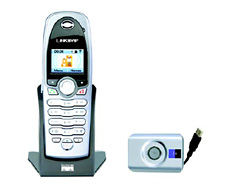
I have been buying and discarding PC phones for some time. Until recently, the experience has been universally bad. Most devices were just cheap microphones and speakers embeded in plastic made to look like a phone. In operation however, the sound quality was bad and the functionality marginal. In most cases, the devices just acted as a microphone and speaker, screwing up your PC in the process.
Happily, Linksys has come out with a truly useful cordless phone that integrates seamlessly with Skype. The phone looks like any other cordless phone, but the base plugs into a USB port on a PC instead of to a phone line. A software program is installed on the PC to make the link between Skype and the cordless phone.
The result is that one now has a cordless phone that can display the Skype contact list, in colour, with the same status symbols one is used to on the PC. Using SkypeOut, the "for pay" long distance service, it is possible to call any phone number in the world for about 2 cents US$ per minute.
My parents were travelling in India and Pakistan over Christmas, and I was unable to reach their cellphone using Starhub or Singtel. Amazingly, I got through using SkypeOut, and for considerably less money than the carriers in Singapore wanted to charge.
I have to say that Linksys has hit a home run with this product. It does exactly what is supposed to do, has a clear colour display, feels good to hold, and has good audio quality. The price is a bit steep (S$179 from South Asia in Funan), but the operational savings are worth it.
Pioneer PDP-436HDG
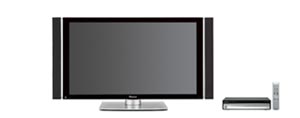
I have been uncharacteristically patient when it comes to getting a plasma TV. When they first became available in Singapore a few years ago, the technolust was real. But doing some research indicated that the technology was developing rapidly, prices were likely to come down significantly, and specs were likely to improve. Of course the fact that they cost more than triple what I had paid for a top of the line TV was also a factor.
With the death of our main TV however, it was time to make a move. The choice was between Hitachi and Pioneer, visibly the best pictures on the market. Nearly identical in price, it came down to features, and this is where the Pioneer wins.
Unlike the Hitachi, Pioneer uses a separate control box to interface with other components. This means that instead of having to run cables from each component to the display screen, all wiring goes to the control box. The control box looks like any other Hi-Fi component, and just sits in the stack with the other devices.
Since I have an AV amp (the Yamaha DSP-A1), it should have been a simple matter of moving the monitor out cable from the old TV to the new Pioneer. However, time has marched on, and the Yamaha does not support component video. There is a visible difference when using component interconnects, so I bypassed the Yamaha and plugged the DVD, DVR, and cable TV directly into the interface box.
Along with the usual inputs, the Pioneer also supports SVGA signals from a PC. There is a video connector on the front of the interface box. This is where the Pioneer really shines. The resolution of the screen is 1024x768, the same as a PC. I connected up the same laptop I have been using to control the CD Jukeboxes, and it worked - full readable text on a 43" screen!
Surfing the web on a 43" screen while sitting in the living room is certainly an addictive experience. I actually find myself looking things up on Google while watching TV. This is either progress or really disturbing...
The only downside to the new setup is the need to switch audio and video separately. Turning on the TV is non-trivial - power on the Pioneer, select input 3. Turn on the Yamaha, select TV. Turn on the cable TV box. Select channel. Control volume through the Yamaha. Yuck.
Time to look for a new AV amp.
Santa Summary
Now that the holidays are over and visitors have been safely returned home, it is time to take stock of the new technology arrivals in the Haunt.
In a genuinely thoughtful manner, our main TV expired just before Christmas, providing an incontrovertible excuse to upgrade. We had purchased this Sony Wega 16:9 format TV on arrival in Singapore ten years ago. It provided yeoman service, and the shipping box served as our dining room table for our first month in our new apartment. So there were no hard feelings involved with the demise. On the contrary, I had been hoping it would expire so that I would have an excuse to get a new plasma.
Along with the need to replace the main display, it was apparent that something needed to be done about the ever mounting long distance telephone bills. While I have long been a user of Skype, the Spouse has never really taken to being tethered to a computer in order to talk to family. Indeed, when she does talk via computer, I lose use of the device, which is no solution at all. Luckily, Linksys had just released their Skype wireless phone and that proved to be the answer.
With some time on my hands, I finally got around to rearranging the PC's in the Haunt. My main workhorse is built on an Asus P4P800E-Deluxe motherboard with a Pentium 4 3ghz CPU and an ATI Radeon 9600XT All-in-Wonder video card. I originally put 1gb of memory, but have been noticing that it is being routinely consumed by all the bloatware one is forced to run. I added an additional 1gb of RAM and things are back to being snappy.
The other PC, also built on the same motherboard but with a 2ghz CPU is now mostly a server, running Skype and the Linksys wireless interface, as well as hosting Slinkserver, which runs the Squeezebox for streaming music to the main Hi-Fi. I tend to also use this machine for lengthy downloads and maintaining backups.
Thursday, December 29, 2005
Which side is Singapore on?
Having survived the Christmas shopping crowds once again, I was struck by the sheer amount of work it takes to walk in Singapore. The problem is that there does not seem to be a shared agreement about which side of the street to walk on, and so one is constantly forced to dodge and weave.
The situation is exacerbated by the government, which periodically puts out public education campaigns with catchy slogans like "Stand left, walk right" for the use of escalators. Trouble is, one can never predict whether the up escalator is going to be on the right or the left, and people generally do the opposite of government campaigns out of sheer bloody mindedness. (or more likely because they just don't care about impeding others...)
The roads are layed out following the British system of right-hand drive, which means cars use the left hand side. One could make a case that people should also walk on the left, which would be fine, as long as everybody agreed. Except they don't. The result is that crowds of people just wander towards each other, and the largest mass wins.
The best way to get a feeling for just how random trying to navigate sidewalks can be is to have a look at this webcam. The view is of an underground link between a subway station and a major shopping mall called Wisma Atria.
As I write this, the mall management have attempted to improve traffic flow by putting barriers down the middle of the passageway to separate incoming from outgoing traffic. In true Singapore fashion, people are randomly walking down both sides.
Singapore
Wednesday, December 07, 2005
Singapore - Christmas is Shocking!

In addition to my previous post on Christmas in Singapore, I noticed a new trend this year. The outdoor decorations and many displays in stores now sport signs saying "DANGER - HIGH VOLTAGE. Pretty interesting for a place where it rains just about every day.
This redefines the concept of a "warm and fuzzy feeling" when looking at displays. Either we have hit a new low in public safety, or the theft rate is significant enough that the display owners are trying a fairly pathetic way of trying to keep people off their stuff.
And yes, for those not familiar with the total crassness of Christmas in Singapore, the picture is of an actual Christmas "decoration" on Orchard Road. I could understand the confusion if you thought it was an advertisment or warning sign...
Singapore
Christmas
Monday, December 05, 2005
Individual Liberty Is The First Casualty Of "The War On Terror"
I was watching a documentary series on the history of Singapore last night on the Discovery channel. Although parts of it were badly disguised ads for Singapore Airlines, the coverage was pretty fair considering the topic and the location.
What came across perfectly clearly was the absolute determination of the PAP to stay in power by whatever means are required. Starting from the basic assumption that they know what is right for Singapore, all is justified in the maintenance and exercise of power. The documentary showed how key members of the party were jailed in the early days, and how the lone opposition MP in the '80's was bankrupted through court actions.
If 4 million people want to be governed this way, that's their choice, though given the constant manipulation of the election rules and constituencies, choice may be too strong a word. In any case, there is little impact on anyone else, as Singapore has yet to "project" its power the way the US is wont to do.
Which is why legal challenges in the US often have importance beyond their shores. A case in point is the legal challenge brought by John Gilmore against the requirement to produce ID before boarding an airplane.
I won't go into all the details here, as Gilmore has an excellent web site with an explanation of his challenge and the political framework within which he is arguing. Suffice to say that it touches on rights guaranteed under the US Constitution to free speech and freedom of assembly, as well as the right to travel freely within the US.
I believe this case is worth watching and supporting because it touches on everything that has been happening since the relationship between citizens and their government was changed by events. From the Kennedy assassination, which justified extraordinary measures to protect the leader, through Nixon's corruption of state agencies to spy on and harass citizens, we can see the organs of state taking measures to insulate themselves from the public and from scrutiny, all in the name of national security.
We have seen the suspension of basic human rights in the name of the "War on xxx" (take your pick of drugs, terror, regime change, poverty) and the militarization of the police in America. Comparing a London bobby on foot patrol to the average American cop with Kevlar body armour and automatic weapons, is to realize just how far things have slid when it comes to what is considered normal and acceptable.
The myriad security and intelligence agencies that have been spawned by state actors richly funded and seemingly answerable to no one is truly frightening. Reports of secret CIA flights carrying unnamed individuals to secret prisons in countries around the world under the doctrine of rendition (a fancy name for state kidnapping) only add to a picture of behaviour which values expediency and views human rights and individual liberty as vexatious impediments to action.
Which brings me back to Gilmore. A self-made software entrepreneur, he has the resources and character to challenge this dangerous tilt towards state primacy over the individual.
The legal briefs filed as part of the case are listed on the web site and are very readable. The next hearing is on Dec. 8, 2005.
I wish him luck for all our sakes.
Singapore
Liberty
Saturday, December 03, 2005
Singapore Broadband - MaxOnline is actually MinOnline
Have just had another frustrating exchange with the helpdesk at Starhub MaxOnline. Although they are supposed to be providing a broadband cable Internet access service, the result is often little better than using an ISP with a dial-up 56K modem.
I dutifully fired off a message to the helpdesk, and attached a number of trace routes to demonstrate the issues I was facing with slow access. The reply was annoyingly familiar - a request for the information I had just provided, along with enough other questions to put off anyone from actually replying. I guess their strategy is to snow the average user with enough technical questions that they will give up and go away.
I didn't.
Like an outsourced desktop support technician with no training ("we will need to re-format your hard disk, Sir"), the solution to every problem seems to be "the fault is at the customer side".
Even though the trace route showed latencies in the high 290 milisecond range for intermediate router hops, I am supposed to believe that the reason I am getting poor performance is because of my PC. All of them by the way, since I have a number to play with, and was getting similar results from each one.
The final answer I received was that there WAS no problem, as the service was within standards as set by the IDA.
Now this was news to me, since I had never seen a published standard for ISP's, and the contract for service clearly indicates that the customer has no right to expect anything other than a bill every month. Sadly, the standards are truly a set of minimums. If a service met these standards, no customer would be having much fun. Nor would services such as VOIP or media streaming work reliably.
And so here are Singapore's broadband standards, courtesy of the IDA.
QoS Standards for Broadband Access Services
QoS Indicator QoS Standard
Network Availability > 99%
Service Activation Time 5 working days or fewer
(from date of receipt of application)
Network Latency =< 85 msec
(connection within the local network)*
Network Latency =< 300 msec
(for the international portion of the network)**
Bandwidth Utilisation =< 90%
(for connections within the local network)
* This latency figure extends from the broadband user to the broadband service provider’s Internet Exchange (IX).
** The international portion of the broadband network extends from beyond the domestic broadband local network up to the network provider’s first point-of-presence in the U.S., or the first point of entry in the U.S.
Singapore
StarHub
Thursday, December 01, 2005
V-Gear Landisk Firmware Upgrade - 021

I noticed that the folks at V-Gear have updated the firmware for the Landisk recently. It is now at version 021, and they have fixed a bunch of nagging issues. It is now possible to set a sleep time for the hard disk, for instance.
The Landisk remains a cheap and simple way to add network accessible storage.
V-gear
LanDisk

 Posts
Posts


