In what has become a tasteless but predictable ritual in Singapore, the Christmas decorations are up before Halloween. I wandered into a department store on Saturday and was assaulted by Jingle Bells blaring from the muzak system.
One suffers a fair degree of cognitive dissonance when hearing "dashing through the snow" while it is 32 degrees Celsius and the humidity is at 92%, but this is magnified by the sheer bad taste of the decorations.
I bet you didn't know that Christmas is brought to you by a major Japanese consumer goods manufacturer. Well it is in Singapore - there are signs every 25 feet trumpeting the fact.
With all the sensitivity to race and religion here, it is amazing that a religious holiday can be so thoroughly hi-jacked by commercial interests without a peep from the supposed adherents.
Singapore
Sunday, October 30, 2005
Singapore - It's Halloween - Merry Christmas


Tuesday, October 25, 2005
Another Week, Another Lake

Sitting by a lake again, this time Lac Geneve, or Lac Leman if you are from Lausanne. My client has their head office in Nyon, and it is time to present to the powers that be.
I flew to Amsterdam as usual, then a quick hop up to Geneva, and another 30 minutes by car to the hotel. The weather is beautiful, there are swans on the lake, and I am flooded with memories. I went to school for one year in Lausanne, just another 40 kilometers along the shore. Truly a beautiful place.
Tuesday, October 11, 2005
Sitting by the dock of the bay...
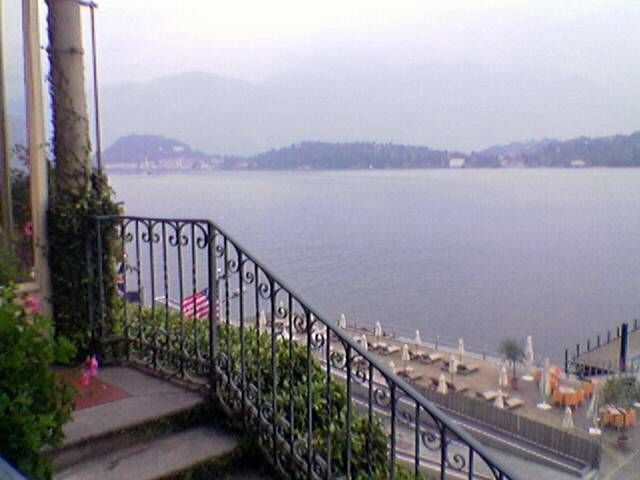
Actually sitting on the terrace overlooking Lake Como in Italy.
It occurs to me that I have been to far too many places without actually seeing them, in a life time of business travel. I have seen the conference rooms of a large number of really nice hotels, and more airports than I can remember.
And of course, the fact that I am connected to the Internet with a Wi-Fi connection in one of the world's great tourist spots is just a special kind of sickness. I can only plead that I AM here on business. Otherwise, I would check myself in for therapy...
BTW, the Lake is beautiful, the hotel is old and full of character, and the food is great. The need to work on PowerPoint presentations is somewhat mitigated by the scenery.
Wednesday, September 21, 2005
Book Recommendation - The Traveler
A curse for any writer is to be consigned to the science fiction category. This immediately limits the exposure and audience for his work, and ensures that he won't make as much money from his labours as he would have with a thriller or other designation.
I don't know how John Twelve Hawks feels about being labelled as a science fiction writer, but he could just as usefully be described as a social commentator. The Traveler is a great read. The plot, characters, and descriptive prose are excellent. The fact that there are science fiction elements should not put off anyone interested in the implications of the war on terror and the erosion of civil liberties.
This is a book that holds the reader's interest from beginning to end, entertaining with a fresh and original take on some very old and important issues.
Highly recommended.
Gainful Employment
Gainful employment is interfering with my blogging. After an extended period of having time to myself, I am back in harness. It basically came down to watching a bank account dwindle or doing something about it, so back to work.
I have just returned from two weeks of visiting a client's offices in Europe. This was a real ironman trip, working during the day, then flying at night to the next city. Not a great way to take in the sights, but effective in accomplishing the goal of understanding the business.
My main impression is that London is obscenely expensive. There is just no way to anticipate the level of prices when arriving from Singapore. My taxi ride from Heathrow to a hotel in Knightsbridge was £88! Which was more than it cost to fly from Sweden to the UK!
I know people think the Chinese Yuan is undervalued, but the £ is clearly overvalued on any rational purchasing power parity measure.
Tuesday, August 23, 2005
Technical - Using A Refrigerator To Repair A Graphics Card
It has been a rather unproductive couple of weeks re-building PC's. What started as a decision to rationalize the equipment lying around the Haunt turned into major upgrade and replacement sessions.
The results are good - two Pentium 4 3Ghz units with new motherboards, and the moving of my main PC, a 2Ghz Pentium 4 built in 2002, to a new motherboard as well.
All three PC's are now running on ASUS P4P800-E Deluxe motherboards. After the disappointments with my Gigabyte boards mounted to the point of pain, I decided to move everything to the same model motherboard, and to use a different manufacturer. The requisite research and local availability led me to ASUS.
One of the last niggling chores was an ATI Radeon All-in-Wonder 8500 DV graphics card that had a cooling fan that had eaten its bearings. After surviving the endless demolition noise from across the street for the past 6 months, it was the final straw when the PC began making tortured metal noises.
With my recently acquired knowledge of PC heatsinks and cooling, it was a simple task to find a replacement heatsink/fan combo (HSF) to replace the failed unit. Except for a seemingly small problem - how to get the existing HSF off the ATI GPU chip?
I tried Googling for an answer, and fired off a ticket to ATI tech support. Guess which route produced the right answer...
It turns out that you need a refrigerator, or more precisely, a freezer. Place the offending graphics card in a plastic freezer bag (to prevent ice build-up from humidity) and leave in the freezer for 24 hours. (You really do need to leave it to freeze solid BTW, just cold won't do.)
With a suitably frozen card in hand, it was now time to pry the HSF off the chip. This is a delicate operation because it is easy to accidentally damage the board . I used a chip pry tool left over from some previous upgrade project and started applying pressure. After a few seconds, the HSF just popped off.
It turns out that ATI uses some sort of thermal glue to hold the HSF. This left a residue that takes some scrapping and alcohol to remove. With a fully cleaned off surface, it was now possible to mount the new HSF on the GPU. I used a Cooler Master Blue Ice HSF as the replacement unit. It is the same size as the ATI GPU, and just sticks on.
The final detail was to connect the power lead for the fan. The original HSF used a 2 pin, 5V connector on the card to power the fan. The new unit was 12 volt, and luckily, a fan connector was still free on the motherboard. I connected the new HSF to this point, and now have the benefit of being able to monitor the fan speed through the ASUS monitoring software.
Oh, and ATI tech support?
"I have explained. ATI does not offer end user replaceable parts on ATI cards. I cannot assist you with this. ATI does not support or recomend end user repairs to ATI cards."
Tuesday, August 16, 2005
Book Recommendation - Woken Furies
The strange and compelling world created by Richard Morgan has been expanded with the release of Woken Furies.
Featuring his protagonist, Takeshi Kovacs, Morgan has delivered another satisfying installment of a future in which one's existence is separated from flesh. This simple device, the technology to remove, store, and implant a person's conciousness, allows truly wonderful plots and twists. As a storyteller, Morgan does a great job of keeping the reader's interest and delivering surprises.
Highly recommended.
Singapore - We Don't Need No Stinkin' Election
In a move that would be familiar to Iran's mullahs, Singapore has decided it does not need an election for President.
This somewhat predictable outcome was managed by the nomination commission deciding that no Singaporean was qualified to run against the incumbent.
The lone individual crazy enough to have tried to run as a candidate has seen his life trashed by the ever efficient combination of forces brought to bear by the state. Although a member of the ruling party for the past decade, he has now "voluntarily" decided to give up his membership.
One wonders about the future of a country that does not have sufficient talent to permit a presidential election every 6 years.
Perhaps a new ministry should be created to look into the problem.
Singapore
Thursday, August 11, 2005
Singapore-style Elections
The inability of Singapore's ruling elite to permit an election to take place without determining the winner in advance is once again on display.
The post of President has been described as "largely ceremonial", yet one would be excused from drawing the conclusion that the very future of the Republic was at stake. The current incumbent is 81 years old and has been coy about "running" again.
Rather than leave the election to the vagaries of random chance, the nomination procedure was tweaked to ensure that only the right people could even run. The requirements for a candidate are so specific that they result in only a handful of people being eligible. Ironically, the original group of individuals who created Singapore would not qualify.
Having raised the bar high enough to exclude most Singaporeans, there must have been considerable disquiet when an individual actually came forward and filed to run. This spilled into the newspaper on Saturday with a piece that can only be described as a crude attempt at character assasination. Using thinly veiled innuendo, the Straits Times manages to imply that this individual is unfit to run. They even manage to dig up a former collegue who dislikes the individual, as if that in itself made him unfit. This has been followed by articles on subsequent days hinting at dark and unspecified character flaws.
One would have thought that the purpose of elections was to allow voters to draw their own conclusions based on the candidates record and platform. But in Singapore it seems, elections are to crown those pre-selected as suitable.
Singapore
Tuesday, July 12, 2005
Leaving Well Enough Alone
The last PC I built from scratch was a Pentium 4 3.06ghz screamer for elder daughter.
I used a Lian Li aluminum case that was similar to the one on my own system, and added the then top of the line ATI Radeon 9700 Pro graphics card to support her gaming needs. The motherboard was the Gigabyte GA-KNXP, and had all the bells and whistles.
Everything worked great when powered up, except for one rather noticeable issue - the thing sounded like a vacumn cleaner on steroids. It was unbelievable. I went through the process of isolating each fan, trying to determine what was causing all the racket. No one device seemed to be responsible, it was just the sum total of a lot of cooling for a lot of heat producing chips.
I tried adding sound damping material to the inside of the case, but to no real effect. And so the situation continued for some time, with occasional pleas to "DO SOMETHING".
As it is now school break, I finally had the time and opportunity to take the offending system apart and try again. The stimulus for action was the announcement that a very well reviewed "silent PC" case was finally available in Singapore. The item in question is the Antec Sonata II, a black monolith of a tower case, supposedly engineered to reduce noise to a minimum.
I purchased the case and set about moving the existing motherboard and components to the new case. Inside, it looks pretty conventional, with the addition of an air baffle that directs cold air directly over the CPU.
The transfer went smoothly, and after a final check, power was applied and the new system fired up. With pretty much the same amount of noise as before. Clearly, the noise was not going to be fixed quickly.
Taking another look at the situation, it was clear that the CPU fan was a major source of noise, rotating at more 6000 RPM. The heat sink/fan combo was the stock Intel kit provided with the CPU which I had purchased retail. Doing some research on the web, I came across the weird and wonderful world of heat sinks, fans, and case modding. Marvellous creations made from solid copper, aluminium, and other exotic metals are available. Water cooling is available. Heat pipes are available. Shapes run the gamut from simple square blocks to circular objects that could happily be shown in a modern art gallery.
As usual though, choice is constrained by the realities of Singapore retail inventory, and so it was off to Sim Lim to see what was in stock. I ended up with a Thermaltake Golf 325 heat sink and a Cooler Master fan to go with it. In the process I passed on a 798gm monstrosity with fins and heat pipes. It looked like it belonged in a nuclear cooling tower.
Back home, it was time to gingerly remove the existing fan and heat sink. The only real danger is that the thermal paste applied between the CPU and the heat sink will have hardened. Luckily, the old rig came off easily, and after cleaning and applying new thermal paste, the new heat sink and fan were attached with some difficulty.
Everything was reassembled and the system fired up. A lot less noise, but still an annoying whine. Checking inside revealed that it was from the fan on the graphics card.
sigh.
Close everything back up, fire up the machine, and blue screen, then death. Try again. No beeps, no indication that anything was happening. The motherboard was powering up, the drives were spinning, but no boot.
Had I cracked the CPU while installing the heat sink? Had I zapped a chip with static? (With humidity at 80%, static is not a major issue in Singapore...) I don't have another motherboard to test the chip or do troubleshooting. Reluctantly, I decided to remove the heat sink and take out the CPU. I needed to verify where the problem was, and that meant eliminating variables. Quick trip to Sim Lim, and managed to get a repair shop to put the chip into a motherboard and it booted.
OK, so now it was looking more and more like something had happened to the motherboard. Because I had been using the onboard RAID controller to run the hard disks, I was concerned that all data would be lost if a different controller was used. I made the rounds of the shops to see if the same board was available, but it was not.
I called the Gigabyte distributor who said that the board was no longer available "because it had problems"! Well thanks for telling me, and so much for warranties and recalls. After years of using Gigabyte motherboards, that really stinks.
With no other choice, I bought a new ASUS motherboard that was highly reviewed on the fan sites - the P4P800E Deluxe. Very nicely layed out, and with 8 USB ports and 1 Firewire port, perfect for what we needed. The board went into the Sonata II easily, components were installed, and the system fired up. IT WORKED!
Lesson learned: Electronic equipment rarely tolerates being handled after it has been running for a long time. It is better to replace than upgrade.
First action: Ignore lesson learned.
With the video card fingered as the noise culprit and with the determination to beat the noise demon still upon me, another trip to Sim Lim, and the acquisition of a Thermaltake Schooner II fanless VGA heatsink ensued. This amazing piece of kit is composed of two black finned heat sinks, a copper heat pipe to join the front and back heat sinks, and a copper heat pipe and radiator which sticks out the back of the PC. Assembly was non trivial, but eventually accomplished and the now fanless ATI graphics card inserted.
Power was applied, the system booted, and there was peace. CPU temperature now showing as 38C vs. 46C before. Mission accomplished.
Total damage: PC case, CPU heat sink, fan, VGA heat sink, motherboard - S$551
DVD sales
A recent article in the Wall Street Journal comments on the fact that both DreamWorks and Pixar are reporting lower earnings due to returns of DVD's. Although films are selling well, retailers are returning stock after only a couple of weeks, unwilling to hold inventory.
The article goes on to suggest that hope may lie in the eventual introduction of high definition DVD, spurring people on to buy more discs.
I really question whether releasing movies on HDVD is going to make any difference to sales.
As a consumer, I have purchased movies on VHS tape, then replaced many of them when laser discs became available. The difference in picture and sound between the formats was compelling, as was the ability to directly access content.
When DVD's came out, I was sceptical. Because they were digital and, depending on the skill of the transfer, could show significant compression artefacts, it was not clear that it was a superior technology. The market quickly made that decision for me however, and laser discs simply disappeared.
Now that I have an extensive library of laser discs and DVD's, am I going to buy the whole library again to get the supposed benefits of HDVD? No.
I would also point to the fact that people are willing to tolerate less quality rather than spend for more.
Music used to be about high-fidelity - the search for reproduction as close to the original performance as possible. Now we have MP3 and the consumption of music has shifted toquantity rather than quality. If the film industry is counting on sales from the pursuit of quality from consumers, they have calculated incorrectly.
Misleading Advertising
Reading advertisements by major businesses in Singapore has become a depressing and cynical affair.
Instead of proudly proclaiming the merits of their products and services, the vendors resort to the worst sort of trickery and ethically dubious behaviour. Prices are not really prices, they are just numbers that have to be analysed through a barrage of fine print and impossibleconditions.
What is the price of a litre of gas? Who knows?
It is just advertised as x% discount. Discount from what?
What is the price of an airline ticket? Who knows?
The fares advertised bear no resemblance to the actual amount payable to fly. Instead of accurately reflecting the cost of the service to be provided, the consumer is faced with mealy mouthed terms such as "excluding taxes, securitysurcharges, airport fees, and fuel supplements".
What is the price of a cell phone? Who knows?
The prices shown are only available if you sign up for lengthy contracts and trade in some phone at an absurdly low value. And don't actually try and trade something in, becausea fault will be found, and the deal will not actually be available.
It is time that we as consumers take action against this abuse of our intelligence and pocket books. Don't meekly accept this commercial flimflammery. Demand clear and accurate pricing when spending your money.
Friday, June 17, 2005
When Laptops Play Games - Part Deux
As it turns out, I didn't go to the PC Show, and I didn't buy a laptop for elder daughter.
The thought of taking part in an un-refereed scrum in order to see something that was available at the local computer store left me cold. It turns out that Acer was offering the same prices and freebies in town as out at the show. I also thought about quarterly price drops and the fact that with the summer school break, the requirement can be deferred a few months.
The main reason is that I am still trying to get over my aversion to Acer. I thought I had it under control but this article in Mobile Magazine has reawakened my trauma of dealing with Acer tech support.
Is it rational to buy a product from a company that scores "Worst Support" in a test of vendor tech support capability?
Wednesday, June 15, 2005
Book Recommendation - Legends
What happens when memories are manufactured instead of experienced? How do you cope with the need to be different people at different times? Can you remain sane, or does your brain melt under the pressure?
Robert Littell has written another great book covering the life of a spy. Set in the time of Gorbachov, the book wanders all over the world as the protagonist is revealed layer by layer. There is the usual attention to detail, with scrupulously accurate descriptions of places and tradecraft.
Unusually, there is a much more interesting angle as Littell tackles the psychological price paid by someone who must dissemble as a profession.
Great read.
Wednesday, June 08, 2005
The Greater Toaster Syndrome - 3G
One of the most frequent reactions I have to new technology announcements is "I know you can, but should you?".
Unfortunately, marketing and momentum often trump common sense. We all know the famous Beta versus VHS example, in which Sony had the superior technology, but Matsushita and JVC managed to out market Sony with VHS.
But there is another problem with technology which comes from doing things because it is possible instead of because it is the best solution.
Let me give you an example.
Back in the early days of consumer computing, there was tremendous excitement about the use of television sets to receive data. The prevailing computing paradigm was centralized processing with terminals to access the host. With the main cost of the terminal being the display, some bright spark decided that since everybody had a TV, it would make sense to add a box to the TV to let it receive data. This was called videotext.
Controlling access to televisions was seen as so important that a veritable arms race ensued between governments to establish their system as the standard and therefore to take over the world. Canada had a system called Telidon based on something called NAPLPS (North American Protocol Level Presentation System), while Britain had Viewdata/Prestel. The French went off and developed Minitel. Singapore is still running their system, 20 years after everybody else gave up.
As a newly minted Trade Commissioner, I was assigned to help set-up the Telidon Marketing Secretariat and sent off to promote the adoption of Canada's standard.
There are actually two lessons I learnt from this experience. The first is never to get involved with technology promoted by a government. I don't think any other episode has so changed my opinion from mild socialism to free market economics.
The second lesson is the one I started this posting with. I call it The Greater Toaster Syndrome. It is the equivalent of sitting in your kitchen and feeling cold. You realize the toaster has a heating element, which you modify at great cost to produce enough heat to warm a room. What you end up with is a toaster that burns toast, costs too much, and makes a lousy furnace.
Telidon and the other systems were flawed because they misunderstood the way people actually lived and used their televisions. You are unlikely to throw the kids off the boob tube to start balancing your cheque book. And not many people had a phone line beside the TV that they were willing to tie up in order to access the host.
All this comes to mind because of the hype that currently exists around 3G telephony. If you believe everything that is being proposed, all other devices are about to become obsolete.
It is possible to make a phone that is also a computer, and play music, and play video, and play games, and receive radio, and act as a flashlight. With enough tinkering, you could probably turn it into a heart defibrillator and a Taser self-defense weapon as well. The point is that the resulting device is unlikely to do anything well.
There is always a danger of being accused of being some sort of Luddite, so the critical assessment of new technology risks getting flamed by the current crop of enthusiasts who have adopted the gizmo as their new religion.
My acid test question is, "nice to have, or need to have?". I hate investing in "nice to have" stuff because it goes away in tough times. Truly new "need to have" technology comes around infrequently at best, but when it does, it transforms the way people function. Think PC's, email, and cellular phones.
In cellular telephony, there was an assumption among the early operators that cellular was just wireline with mobility, for which a premium could be charged. All that changed when the Nordic countries started abandoning the concept of long distance, and charging all calls at the same rate regardless of location. What is the point of an area code when you are mobile?
The next big change came when the kids figured out that there was an embedded messaging system in GSM called SMS. Instead of talking as expected, they started "texting". Quite a few carrier revenue spreadsheets went up in flames when SMS took off.
Never underestimate inertia or group think though. When spectrum became available for 3G, and the fantasies of mobile Internet access at 2mb became common, financial bids were placed for spectrum licenses that guaranteed to bankrupt the industry. Not unexpectedly, one finds governments guiding technology in this fiasco. What Finance Minister could resist the idea of auctioning off spectrum (which no voter could see anyway), and balancing the budget at the same time?
While their customers are happily texting each other, the cellcos are trying to figure out why nobody is paying hundreds of dollars a month in data fees to download content and swap photographs.
3G has the potential to offer meaningful services, but that is not going to happen with conventional thinking. With the cellcos trying to hold onto access, devices, and content, in order to pay off their massive license debts, it is unlikely that anything innovative is going to emerge. It will take a cellco with sufficient humility to realize that good ideas come from the market, not internally.
When Bankers Go Wild - Standard Chartered
The online banking scene in Singapore can be pretty frustrating, with mediocre offerings and limited features. Recently however, Standard Chartered appeared to be offering something akin to the wonderful ING Direct, which is unfortunately not available here.
The new online only account from Standard Chartered is called e$aver, and offers the highest interest rate in town for a demand deposit. As a long time customer, I immediately logged on and attempted to open an account.
Which is when things started to go all pear shaped. To recap, I am an existing customer using an existing secure connection to access online banking. First step to place a deposit is to open a new account.
OK, I can see that it needs a separate account number, but why do I need to re-enter all my personal data? I have been a customer for 10 years.
All questions are compulsory, so if you don't answer, no account
Mobile phone number. No mobile phone, no account.
Employer, annual salary, net worth, annual income...
Hey wait a minute, I am trying to DEPOSIT money, not borrow it. Why the third degree on what would be barely passable questions for a credit card application?
It gets better.
Gender, Race. Now what the hell does gender and race have to do with bank deposits? Does Standard Chartered plan on offering differential rates and services depending on your race?
With weekly revelations of data loss by major financial institutions, this kind of data harvesting overkill is inexcusable. If you answered every question, you would be completely vulnerable to identity theft.
When I questioned the customer service rep as to why they needed so much information from an existing customer to make a DEPOSIT, she said it was a 9/11 "know your customer" regulation of the Monetary Authority of Singapore. When I suggested that it was pretty far fetched to suggest that terrorists or those funding terrorists could be identified by gender or race, things got quiet.
Perhaps bankers in Singapore are unfamiliar with the Universal Declaration of Human Rights, which in article 2 states:
Article 2
Everyone is entitled to all the rights and freedoms set forth in this Declaration, without distinction of any kind, such as race, colour, sex, language, religion, political or other opinion, national or social origin, property, birth or other status.
Furthermore, no distinction shall be made on the basis of the political, jurisdictional or international status of the country or territory to which a person belongs, whether it be independent, trust, non-self-governing or under any other limitation of sovereignty.
Next stop was the MAS web site to see if there was anything concrete about information required of customers. The menus didn't provide anything, but the search engine threw up a document that looks like it covers the subject of prevention of money laundering - MAS 626. A quick read and nope, nothing about gender or race as an indicator of malfeasance.
One pretty reasonable sentence, "The list is intended solely as an aid, and must not be applied as a routine instrument in place of common sense.", and one slightly scary sentence, "It is justifiable to suspect any customer who is reluctant to provide normal information and documents required routinely by the bank in thecourse of the business relationship."
That last one is tough. If you try and question the bank's unrestrained data collection, you risk being labelled a money launderer.
The ultimate remedy remains taking your business where it is safe and welcome.
Singapore
Banks
Friday, June 03, 2005
Music Recommendation - Eva Cassidy - Live at Blues Alley
I have pretty wide tastes in music, from metal to classics, so it is not often that I am surprised by hearing a singer for the first time. I had read a story in a business newspaper about the fact that sales for an artist who had died were continuing strongly. The description of the music intrigued me enough to go buy a copy.
Eva Cassidy was not someone I had heard of during her lifetime. She died in 1996, but apparently her label has continued to issue albums. This album is of live performances at a Washington D.C. blues club.
Eva has an amazing purity and range of voice. Her song choice covers standards, blues, folk, gospel, whatever. You simply get captivated by her voice and the emotion she puts into every song.
Get this CD.
Unintended Consequences
I awoke to bird song this morning. A simple fact that is taken for granted by most, but something that has been missing from my life for the last six months.
In what was a quiet residential neighbourhood, permits have been granted for the demolition of a number of relatively new buildings. Why? I can only assume that profit is the motive, since the old buildings did not need replacing, and the new ones will change the character of the neighbourhood.
Allowing demolition of buildings in an existing residential neighbourhood has had a devastating impact on those of us forced to endure 10 hours a day of pneumatic hammers breaking concrete.
Although I have sought help from the Building and Construction Authority, the Environment Ministry, and my MP, nothing has been done to mitigate the noise. Current legislation permits operations to continue 24 hours a day within noise limits that would be considered cruel and unusual punishment if inflicted on a prisoner.
Yet today there is silence and all work has been halted. Could one assume that the organizers of the international forum in the hotel near by found the noise objectionable? Like the sudden clean ups proceeding visits by ministers, it would appear that our best hope for peace and quiet lie with continued international conferences or a VIP taking up residence.
Thursday, June 02, 2005
Dead Pixels and the Art of Shopping
With the annual PC Show now on in Singapore, it is time to get serious about the acquisition of a laptop. While the show itself is a nightmare because of the poor booth layout, the occasion does stimulate the various vendors to offer "deals". So far, the price of the Acer has dropped S$300 and a bunch of freebies are being offered as well.
The normal way to buy computers in Singapore is to head to Sim Lim Square and bargain your posterior off with the various sharks that inhabit that storied building. The pricing one gets at the PC Show represents what would pass for a decent deal at Sim Lim - probably not the absolute lowest price, but one that beats retail - and with a lot less hassle.
The problem with all computer trade shows in Singapore is the seeming lack of any regulation by the authorities. The booths are arranged so closely together that it is impossible to walk down the corridors. The experience can be quite frightening if you are small, short, or in any way intimidated by crowds. If a fire or other emergency were to occur, people would die, it is that simple.
The dead pixels referred to in the title are not the victims of attending the show, but rather a problem with LCD screens. Unless great care is taken and quality standards are high, one or more pixels in a screen may malfunction. The effect is to have a dot on your screen that is always on, or conversely, black all the time. Depending where the dead pixels end up, this can be enormously irritating. For those doing pixel level graphics work, it is impossible to accept.
The manufacturers of course would have you believe that this is normal, and that they bear no responsibility for bad pixels. The analogy is that you buy a car with a windshield that has random black spots on it.
I don't think so.
As a consumer, you need to exercise discretion before you purchase. Depending on the vendor, you will get little or no sympathy if you try and return a laptop because of dead pixels. My "favorite" vendor, Acer, states on their website that anything up to 7 dead pixels is considered acceptable. Not to me!
So how do you protect yourself before the money is handed over? Clearly, buying online is not going to work unless you can get the vendor to explicitly accept your order subject to no dead pixels. It is worth a shot.
Preferably, you want to be able to test the screen yourself before taking delivery. And for that, some software helps. Over at LaptopShowcase, a program by Chris called Dead Pixel Buddy allows you to run a screen through its paces and determine whether any pixels are defective.
Armed with this little gem on my trusty USB flashdrive, I am off to the PC Show tomorrow to do battle with the forces of commerce.
Wednesday, June 01, 2005
When Laptops Play Games
There should be a natural lifecycle for computers at home. The big guy (me) gets the biggest, baddest machine possible. When age (the computer's, not mine) sets in, the PC gets passed on to oldest child and so on.
Well yeah, in some other parallel universe.
What actually happens is that the big guy (me) spends a lot of time doing tech support and tweaking the biggest, baddest PC owned by oldest daughter, while continuing to get by on the 2002 model.
The explanation and blame lies at the feet of 3D games. Running Quicken doesn't suck up that many CPU cycles, but GuildWars sure does. The kids are running frame rates and CPU loads that would have crushed the average nuclear research lab 5 years ago.
And so to the point of this ramble. I need to get a laptop for elder daughter to replace her monster PC. I thought this would be relatively simple since the IBM (Lenovo) ThinkPad T series remains the best laptop out there. Unfortunately, it does not have the GPU to handle games.
There is a category called "Desktop Replacement" in most laptop reviews, but on closer examination, it appears that most of these units have very basic graphics capability. Nothing close to what is required for serious 3D play.
So far, I have been able to track down only three laptops available in Singapore that have top end graphics cards - the Dell Inspirion 9300, the Acer TI8104, and the Acer Ferrari 4000. There is another Dell, the XPS laptop which seems to be only available in the US and Canada.
I have dealt with Dell for many years and purchased thousands of their PC's for various companies I have worked for. Great people, great products. Lousy laptops. Dell, like most other vendors OEM's their laptops from Taiwanese vendors. There is nothing inherently wrong with that, just that the value add can be pretty small, and the product is not likely to have had the same scruitiny during manufacture as something assembled in-house.
Acer on the other hand has been a universally terrible experience. I bought a 19 inch monitor from them many years ago which spent a considerable amount of its life in the service shop. On liberation, it celebrated by bursting into flames and melting down. Luckily I was at home at the time and managed to contain the damage to one charred desk.
Against my better judgement, I bought a PC from Acer some years ago. What looked like a deal turned out to be a dog, with missing cache memory and low spec parts.
Since then, Acer purchased the laptop operations of Texas Instruments, and continues to differentiate their product line between Acer and Acer TI models. The one that has the gaming credentials is in the TI line. The online reveiws have all been good except for a few complaining about hellish service. Sounds familiar...
Comparing specs, the Acer comes out slightly better than the Dell at pretty much exactly the same price.
If you have any advice or experience to share about good gaming laptops, please do add a comment to this entry.
Thursday, May 26, 2005
Book Recommendation - A Long Way Down
With what at first glance would appear to be a depressing plotline, Nick Hornby has written a humourous, thought provoking novel about suicide, life, and what it takes to get off the ledge.
A Long Way Down is about four people who accidentally bump into each other on New Years Eve. They have all, for different reasons, made their way to the top of a building and planned to jump. The novel explores why they ended up there, and the group dynamic that ensues.
This is not Chicken Soup For The Soul, but rather more black humour and insight into what makes ordinary lives livable. It is a quick and satisfying read that opens some doors in one's brain normally kept tightly shut.
Highly recommended.
Monday, May 16, 2005
LAMP goes limp - WAMP to the rescue
sigh.
After researching, reading, installing, configuring and getting increasingly frustrated, I have to admit partial defeat.
The quest to build my own database driven webserver has foundered on the reality that you ought to know Linux really well before you try this. The combination of Linux, Apache, MySQL and PHP, known as LAMP, does work, and there are a number of different scripts to have it all installed. Ultimately though, you still need to fiddle and tweak, and I am just not comfortable doing that in Linux.
On the off chance that all the work was not in vain, I started looking for the Windows equivalent of the AMP part of LAMP. I was surprised to find that they all existed, and there was actually something called WAMP, which is the Windows equivalent of LAMP.
I decided to start over with the old Dell XPS I have been using for this project, and install a clean copy of XP. I figured I might as well go all the way to SP2 and test out that whole can of worms at the same time. Some additional research and I learned how to create a new install CD with all the patches already "slipstreamed". I'll do a separate entry on this later.
With a fresh OS in place, it was just a matter of running WAMP5, an installation script and .exe package that sets everything up automatically. With that done, it was time to select a content management system to manage the web site.
Much researching later, and when I regained conciousness, I had selected Mambo as the environment. This requires the downloading of another zip file, and the extraction of the PHP scripts into the web server's document directory. After configuring passwords and directories with the admin tools included in WAMP5, and with a final edit of a config file, automagically, a pre-canned web site appears.
With the basics in place, I now have a working web site and content management system in place and accessible across the LAN. Next step is to learn more about how to use Mambo.
More later.
The Ultimate Google
Google's transformation from plucky underdog to Orwellian master is complete now that satire sites have started appearing.
For those who feel just the slightest discomfort about the control that Serge and Larry have over the Internet at this point, The Google Content Blocker should provide some food for thought.
Muzzled in Singapore
A week has gone by since I last posted. The relentless barrage of noise from the demolition next door continues to make coherent thought impossible, and I have been watching, with increasing disquiet, the recent cases of Singaporean bloggers being threatened with lawsuits by those who disagree with their postings.
It certainly has a chilling effect, since one is unable to determine in advance what will provoke the ire of the authorities. In Singapore, these invisible boundaries are referred to as "OB markers" or out of bounds markers. You can say anything you want unless you cross the boundary. The trouble is, nobody can figure out what the boundaries are in advance. The resulting self-censorship is extremely effective in limiting debate.
A group of filmmakers wrote a letter to the Straits Times asking for clarification on what is permitted, as yet another film was pulled from the local film festival for "being political". It turns out that it is illegal to make a film that involves party politics, and the subject of the film was the leader of one of the opposition parties.
The problem of course is that "politics" is never defined. It seems to be whatever you are doing that the authorities disapprove of. If you want to lobby for a speed bump on your street, and talk to your neighbours to gain their support, is that politicking? If you express an opinion on a blog which can be read by others, is that politicking?
If you are not a Singapore citizen, but a permanent resident or visitor, things are even more dire. As the head of the SIA pilots union discovered, you can go from being a respected long term resident to undesirable alien over night.
today's Straits Times (May 16, 2005) had this gem of a quote from an unnamed government official at the Ministry of Home Affairs.
The spokesman reiterated the Government's stand that politics in Singapore is reserved for Singaporeans.
Foreigners like Mr Moser-Puangsuwan 'with no stake in the future of Singapore and of Singaporeans will not be allowed to interfere in Singapore's domestic politics, much less to instigate, agitate and promote civil disobedience among targeted segments of society, against the laws of the country'.
The spokesman said foreigners who abuse privileges given to visitors here, and who seek to meddle in domestic politics, 'are not welcome here'.
Quoting from the Straits Times article again,
This (workshop) was aimed to teach Singaporeans how to wage a non-violent campaign of civil disobedience against the Government so as to liberate and expand civil rights of Singaporean citizens who, he deludes himself to believe, are living under dire oppression and injustice.
One would hazard a guess that if Singaporeans did not feel that they were "living under dire oppression and injustice", Mr. Moser-Puangsuwan would be unlikely to find an audience and would therefore be talking to himself, hardly posing a threat to the stability and continued existence of Singapore.
One wonders what would happen to a Singaporean who decided to offer a workshop on civil disobedience. Luckily, the Internal Security Act is available to deal with any such threats.
Time to go back to the shopping malls, where there are no politics, and both the customers and the air are conditioned.
Singapore
Saturday, May 07, 2005
Another Librarian Speaks - blogs and bloggers are crap
It seems the gatekeepers are continuing to feel the pressure from all the "unauthorized" publishing going on these days. The latest outburst is from Blaise Cronin, who once again avoids the real point by denigrating the bloggers instead of figuring out how to take advantage of the technology.
One wonders for whom these hapless souls blog. Why do they choose to expose their unremarkable opinions, sententious drivel and unedifying private lives to the potential gaze of total strangers? What prompts this particular kind of digital exhibitionism? The present generation of bloggers seems to imagine that such crassly egotistical behavior is socially acceptable and that time-honored editorial and filtering functions have no place in cyberspace. Undoubtedly, these are the same individuals who believe that the free-for-all, communitarian approach of Wikipedia is the way forward. Librarians, of course, know better.
Indiana University Dean and Rudy Professor of Information Science Blaise Cronin
Broadcast Flag at half mast
A US appellate court has struck down the infamous "broadcast flag" rule brought in by the FCC and its friends.
This rule would have required all devices sold in the US capable of receiving or recording digital broadcasts to implement a broadcast flag by July 1, 2005, to prevent further distribution of the content
Since the rule would have prevented something as simple as recording a TV program, there was naturally considerable opposition. A case was brought against the FCC by the American Library Association on behalf of those opposed, and the Motion Picture Association of America intervened on behalf of the FCC.
The court overturned the broadcast flag rule on the grounds that FCC had overstepped its authority. Congress had never given the agency the power to regulate the use or manufacture of devices after they received a transmission. This is a relatively narrow ground for invalidating the rule, and does not address the issue of fair use.
With the music and film industries unable or unwilling to adjust to technology shifts, these constant assaults on the freedom of an individual to use goods purchased in good faith will continue.
The whole idea that the manufacturer somehow retains rights to how a product is used after it is sold is pernicious.
We have seen lawsuits about mod chips for video consoles, software becoming nothing more than a license (you don't own it, just the right to use it in the way the manufacturer permits), and music and film becoming so schizophrenic they don't know what they are anymore.
Am I buying a CD or just licensing the music? If it is a license, why won't the publishers replace broken CD's? If it is a license, why won't the publishers replace obsolete media with new media as in the transition from vinyl to cassette to CD to MP3?
The decision of the court is quite readable and is available here and here.
Thursday, May 05, 2005
What's Your Name? No, really....
If you surf the web widely, you have been presented with endless requests to register before viewing content. And if you follow any sort of security best practices, you need to invent different login and password pairs for each site. And then keep track of them all.
Bugmenot to the rescue! This site brokers the exchange of logins so that you don't have to create your own. Just enter the URL of the site you are trying to enter, and Bugmenot will supply you with a login and password.
All the userids and passwords are created by users, presumably with fake data, so it becomes a matter of adding a pair if a site is not already listed, or using what is there already.
kewl.
Thursday, April 28, 2005
Singapore wants to get dirty
Like the A student who starts hanging out with the guys taking shop, Singapore has decided that it is too boring and needs to add some excitement.
The first physical manifestations of this took place last year when the operator of a reverse bungee was given a licence, AND bar top dancing was permitted under certain circumstances. (presumably not while on the bungee).
With this radical unbuttoning, it was only a matter of time before things really got crazy.
After carefully preparing the public through the usual trial ballons and op-ed pieces in the local press, the government has now announced that it will permit two IR's. No, not infrared, but Integrated Resorts, the Singaporean code words for casino gambling.
One can hardly wait. Maybe things will completely go to hell and Singapore will host the world chewing gum spitting championships...
Singapore
Juniper (JNPR) buys Peribit and Redline
Juniper, the only company that really keeps Cisco awake at night, continues to make interesting and strategic acquisitions. They have already purchased NetScreen (VPN and firewall).
This week they have announced the purchase of Peribit, the makers of excellent WAN compression boxes, and Redline, a maker of web application accelerators.
I have personally put Juniper's large core routers into a corporate, and used the Peribit compression to dramatically cut WAN expenses. Having the capabilities in a single product family is a really smart move on Juniper's part.
Anybody who still just automatically buys Cisco because it is safe is missing the plot.
We Know Who You ARE
I often come across web sites, emails, and IP addresses that I would like to verify in some way. Are they really who they say they are? Where are they located?
There are any number of sites you can find that do lookups for individual pieces of information. But for the most comprehensive one stop query page I have ever seen, check out DNSstuff. There are more than 20 different query and test links, all grouped on a single, easy to use web page. No need to install any software.
Great stuff.
Sunday, April 24, 2005
Cleaning Up After Yourself
Thinking about privacy and security brings to mind another useful utility that should be on every Windows PC - Crap Cleaner.
This freeware gem goes in and cleans up all the footprints and detritus left after a hard day surfing. I was astonished the first time I ran the program to find that it had removed more than 80mb worth of files from my computer. The number of nooks and crannies that contain data are truly amazing, and ccleaner deletes all traces quickly and painlessly.
Highly recommended.
Friday, April 22, 2005
Profiling Your Computer
Keeping complete image backups is the only practical way to restore a PC after a crash, but what if you need to start all over and install your software from scratch?
After you have been running Windows for a while, the registry is filled with an accumulation of broken and obsolete enteries that slow down performance. Although there are tools to "clean" the registry, they are fraught with problems unless used very carefully.
It is incredibly tedious to re-install, but if you must, one way to at least ensure that everything gets restored is to take an inventory of what is currently installed. Clicking on Start|All Programs shows you a list of what Windows thinks is there, but there is no way to print this easily, and programs that did not create Start entries will not be shown.
Belarc comes to the rescue. Free for personal use, the Belarc Advisor is a remarkable program that generates a complete listing of all hardware, peripherals, OS patches and software on your computer. I was astonished to find that I had hundreds of programs installed.
The listing produced by Belarc is generated in your browser as a web page with links. It also shows licence keys for software, something which is really important to have in a single place when re-installing.
Highly recommended.
Wednesday, April 20, 2005
When Your Passport Can Get You Killed
The balance between privacy and security for all of us was fatally disrupted when the United States decided that it was at war with terrorism.
To be at war with an idea, with a consequence, instead of a country or person is not an easy thing to manage. The first casualty of the war on terrorism was the ability to express an opinion. This is often referred to as free speech, but as history shows, it is an early and frequent victim of conflict.
When crowds, or countries, decide that they are threatened by "them", some pretty ugly things start happening. An enduring image for me is of a 61 year old man being arrested at a shopping mall for wearing a T-shirt which said "Peace on Earth, Give Peace a Chance".
I have tried to avoid travelling to the US by air after a number of incidents which were both unpleasant and unnecessary, and inflicted by the screening personnel at airports. There is nothing you can do as a traveller but submit, however outrageous the request.
And so to the US campaign to force all other countries in the world to issue new passports. These documents are to have biometric and biographical information on an unsecured, unencrypted chip that can be read by a contact-less proximity reader. The US has actively and successfully argued against encrypting the information on the chip or allowing safeguards to prevent unauthorized data acquisition.
Which means that you can be scanned without your knowledge and have all your personal details picked up by someone who may or may not be doing so for innocent reasons.
There is an excellent overview of the technological and societal implications written by Scott Bradner in his NetworkWorldFusion column.
I find it difficult to think of a positive outcome for any of this.
Tuesday, April 19, 2005
Meta Search with TurboScout
A local Singaporean student has created a useful meta-search web page called TurboScout that submits your search query to more than 90 search engines.
The interface is googilian in its simplicity, and the expanded search universe delivers truly useful results. For those using Firefox, there is also a code snippet to add TurboScout to your search box on the toolbar.
Can't ask much more for free.
ZabaSearch
We have all become used to the simplicity of finding things on the web with just a few clicks. Google is a verb, so what can come along to make you take a deep breath?
How about a search engine that finds people, gives you all their personal data, draws a map with directions to their house, and to top it all off, has a satellite photo? Welcome to ZabaSearch.
ZabaSearch was launched at the end of February, 2005 and is just amazing and scary. An excellent review of the site was done by David Lazarus in his San Francisco Chronicle column.
The site appears to work better in IE than Firefox, where the links were not clickable.
In a world in which nothing is private, anonymity is your most precious asset.
Skype to your wireline phone
I mentioned in an earlier entry that Skype was starting to cause an add-on industry. A good example was brought to my attention in the form of the MPLAT Skypebox B2K.
Apart from the ugly name, this is a neat little device that creates a physical connection between your PC running Skype, and your wireline phone. Which means that you can not only answer incoming calls on a normal phone, but also place outgoing calls.
Now, this is not a replacement for the SkypeOut service which lets you dial to a PSTN number. You would still need a SkypeOut account with pre-paid credit to do that. Rather, the MPLAT uses some clever software on the PC to assign speed call numbers to your Skype contacts, then lets you dial them from the wireline phone.
There is a complete explanation of how it all works, with diagrams, here.
Monday, April 18, 2005
Open Letter to the Building and Construction Authority
Update: Received the following from the BCA today, after a conversation with one of their people:
Dear Mr. Hanafi
I refer to your teleconversation with our Ms. Catherine Wong this
afternoon.
We are looking into the issues raised by you in your email. In the
meantime, if you have further questions or feedback, please feel free to
contact me.
Thank you.
Regards.
Goh Meng Hwi - Engineer - Building & Construction Authority - Tel: +65
63258967 - Fax: +65 63257482
Call me cynical, but one does rather think that the investigation will be finished just about the same time the building is demolished...
==========================
I have been off the air for the last few days, beaten into submission by the relentless pounding of heavy construction equipment being used to demolish a re-inforced concrete building across the street. In the finest Asian tradition of non-regulation of anything that gets in the way of making money, there are no meaningful rules for acceptable limits to noise and duration of operations.
Although ultimately futile, I sent the following to the government agency involved, and the Straits Times editorial page.
Dear Sir,
I am writing this letter from my desk at home while feeling slightly queasy from the swaying of the building I live in. For the past 108 days, the building directly across the street has been under demolition from 08:30 in the morning until 19:00 at night, 6 days a week. They appear to be half finished. The impact is similar to living in Beirut during the civil war - constant noise, dust, and earth-shattering impacts, while enduring your home shaking and swaying.
The building being demolished was not old or unusable. Indeed, it was younger than the one I currently live in. It is being demolished because the owner believes that they can make more money by tearing down the current structure and building a new one with smaller apartments and higher density. While I am firm believer in the capitalist system, their profit is coming at my expense. There is no national interest being served here, just profit. But the costs are being borne by those of us forced to live nearby.
Singapore is a heavily urban environment. Thousands of people live within 500 meters of the demolition site, yet the technology being used to demolish the building is extremely primitive - hitting concrete with pneumatic hammers. It is time to realize that conventional demolition methods are inappropriate for urban environments, and that something better and faster needs to be used.
I call on the Building and Construction Authority to bring in regulations that protect citizens from the effects of demolition projects. As a start, there should be requirement for the use of controlled demolition (use of explosives) to demolish buildings in residential areas. This is a well-understood and safe technique which brings down a building in a single controlled explosion. There should also be compulsory use of acoustic shields on pneumatic hammers to control the noise. The allowed work hours need to reflect the reality of their impact. People need rest, and students need to be able to concentrate. Hammering should be restricted to 9-5 during weekdays, and not on the weekend at all.
There are at least 2 other buildings scheduled for demolition in my immediate neighbourhood, so this is not an issue that is going away any time soon. When you multiply the situation by all the sites across Singapore, this is a major problem.
Monday, April 11, 2005
The Ecology of Skype
One of the marks of success for any product or service is the emergence of communities, accessories, pundits, copies, and newsletters. This has happened with the iPod, Amazon, Google, and blogging.
The latest entrant to this level of interest is Skype, the free VoIP service that lets anyone connected to the Internet talk with anyone else. There are now enough services, products, hacks, and activities that have come into in existence, to describe an ecology of Skype.
Any one who uses Skype regularly has sought out better hardware - echo cancelling microphones, comfortable headsets, physical phone interfaces.
There is a blog/forum called Skype Journal, which covers the service itself as well as the ecology and potential impacts.
The equivalent to podcasting has emerged as skypecasting, in which content is played back out over Skype, creating the ability to be your own broadcaster. More troubling, content can also be captured during Skype sessions and turned into MP3 files for playback and distribution. A good reminder that anything you type or say on the Internet can come back to haunt you.
I really wonder if the old-line telco equipment makers are going to survive this latest shift in their universe. They tried to ignore data for a long time, then scrambled to integrate IP voice into traditional PABX equipment, still charging millions for large systems.
Meanwhile, every desktop has a PC and it is just a matter of habit catching up with reality. You can't have cubicle dwellers in open plan offices all yelling at their computers, but you definitely can marry the idea of a handset with a PC.
Throw instant messaging (IM), calling regular phones, conferencing, and soon, video, into the mix , all also provided by Skype, and you have a genuinely disruptive change on your hands.
Apart from the obvious impacts on traditional businesses, there is also a change in the way we interact. Email broke the conventions of "proper" correspondence by turning written interaction from the formal to the casual. Speed also changed expectations of politeness, and the pressure to respond. IM ratcheted up the pressure even higher, because now you can have a continuous conversation regardless of distance.
A recent program on the BBC World Service had an academic talking about how his collaboration with a colleague in Japan had changed with Skype, because they no longer say hello and goodbye, they just talk when it is appropriate.
Since Skype can also work on PDA's and wireless devices, and people with way too much time on their hands have figured out how to put Internet access into airplanes, we have truly arrived at a permanently connected world.
Yikes.
Sunday, April 10, 2005
Nokia PC Suite - New Version for 9500 Communicator
A new version of the PC sofware for connecting and synchronizing a Nokia phone to a PC has just been released. Called PC Suite, it is now at version 6.5 and is available here.
The previous version certainly had issues, and this version is supposed to have dealt with the bugs. I am hoping this one will handle things more smoothly. I have also updated my page of links to Nokia 9500 software and resources.
Saturday, April 09, 2005
Don't Let Cellular Carriers Bully Manufacturers
A recent recent opinion piece in the Straits Times suggested that it was a good thing for cellular carriers to be able to dictate how phones should be made and released, and that this shift of power from the manufacturers to the carriers would be a good thing.
The reality is quite different. GSM has become the success it has precisely because the Nokia's and Ericsson's of the world refused to be bullied by the carriers. The carriers are only interested in "lock-in"- they want you to buy your phone from them and then make sure you have no choice by ensuring that the firmware in the phone is unique to their network.
If the world worked as suggested, there would be an end to innovation and an increase in prices. New services work because they are ubiquitous and follow open standards. Closed, proprietary systems rarely gain traction.
To see the kind of abuse that follows carrier modified phones, look at the experience of Treo 650 users in the US. If you buy a Treo off the shelf, it has Bluetooth. If you buy it from Verizon, it has Bluetooth turned off. Why? They want you to use their network to move information, not an off-net technology like Bluetooth for which they cannot charge.
Singapore has been relatively "clean" in that you can buy phones from any manufacturer and use them on a local network. The SIM cards are locked to prevent local roaming, but otherwise do not suffer from restriction present in other markets.
It would be a huge step backward to argue for an end to the healthy and innovative competition that has delivered benefits to device customers in favour of giving further power to the telecom oligopoly.
In Praise of Sidekick 98
After posting my reminiscence of old software, and Sidekick 98 in particular, I have come across a number of other people who feel the same way.
There appears to be an active Sidekick community running over at Tech-Tips, with new forum postings happening daily.
There is also a web site which hosts FAQ enteries and downloads here. The postings contain some excellent information about keeping the program running, and how to import and export to various other programs.
Friday, April 08, 2005
The VCR is dead - long live the DVR
A vulnerable moment (left alone by a momentarily distracted wife in an electronics store during a sale) has led to the invocation of Bell's Law and the addition of a shiny new Pioneer DVR-520H to the home theatre setup.
Living in the heat and humidity of Singapore has not been kind to our VCR tape collection. Many of the pre-recorded tapes purchased more than 10 years ago are unusable. There is also the palpable shock of switching from the clean high resolution picture provided by a DVD. Going back to the old grainy VCR and waiting for the thing to rewind, only to miss all the great sound coded on the equivalent DVD is just too much.
We have had DVD's and players since the format was first released, but the VCR was the only available device to do time-shifting. Being in Asia, there is no TIVO or G-code recording. Definitely created a sense of deprivation.
DVR's with hard disk recording and built-in DVD burners started showing up last year, but at ridiculous prices. By the Chinese New Year sales this year, things had calmed down enough to punish the plastic and bring home a new toy.
After looking at all the various flavours of DVR available here, I decided it really came down to a choice of UI and remote. In other words, it is digital recording, so there won't be much difference in the actual recording, just in how easy it is to program and operate.
The Pioneer DVR series quickly emerged as the most sensible and practical package. It really is a pleasure to use, with just a few key presses to set up a future recording event, to retrieve a recorded program, and to burn a permanent copy.
Highly recommended.
Wednesday, April 06, 2005
Book Recommendation - Setting Up LAMP
Continuing the adventure of building a computer to provide myself with a web server driven by a database, I needed more handholding and information, so it was back to the book store.
The components have been selected on the basis of their being a) open source, and b) well documented. That led me to Linux for the OS, Apache for the web server, MySQL for the database, and PHP for the scripting language. This combination is known as LAMP.
A review of the available books for LAMP newbies, and I settled on "Setting up LAMP". As advertised, it takes you through all the installation and configuration issues without assuming any prior knowledge, the achilles heel of most computer books.
Highly recommended.
Computing Appliances versus Configuration Control
As both a CIO and a home user, I have long been frustrated with the trade-off that was required between accepting a computing appliance with limited capability, and the power and complexity of rolling your own.
Often, appliances have been from obscure manufacturers, and tech support is not something that can be counted on. This has led to most people avoiding appliances in favour of the tried and true process of selecting hardware, operating system, building the application, and configuring the parts to work as a whole.
OTOH, non-existant manuals shouldn't be a problem if the appliance is truly plug and play. There are appliances for spam and virus prevention, firewalls, and web servers. But the first ones to pass the plug and play test were probably NAS appliances. Why go to all the trouble of building a full system when you just need a bunch of disk attached to your network? There are relatively expensive NAS appliances running proprietary operating systems from people like Netapps and EMC, mid-price NAS appliances running Windows from Dell, HP, and IBM, and cheap NAS appliances running various flavours of Linux such as the V-Gear which I reviewed previously.
The most interesting development has been in the all-in-one box that allows a SOHO user to have a complete computing environment without having to hire an IT team or pay big bucks for hosting. The folks at Axentra have come up with a neat little box that appears to do everything, with minimal initial setup handled through a web browser. The product is called the Net-box SOHO-400.
Friday, April 01, 2005
Telecom Policy Needs Work In Singapore
There is an ongoing fight between the two wireline providers in Singapore because of a basic mistake made by the regulator when monopoly telco operations were ended.
StarHub is refusing to provide service to customers in various locations around the country because of a dispute over the pricing of SingTel's circuits.
Underlying the present dispute is the larger issue that StarHub has not been given equal access to the in-ground conduits that are used to run telecom cables throughout Singapore.
SingTel enjoyed monopoly rights and unfettered access when it built the existing in-ground conduit access system that is ultimately at the heart of the dispute. Having been allowed to dig up the streets and enter every building in the country, it now is suggesting that StarHub undertake a similar task on its own.
This is not an unusual state of affairs around the world, where most countries have had to deal with an incumbent monopoly refusing to give up its privileged position, while permitting competitors to enter the market in a way that permits them to be economically feasible. SingTel was paid a considerable amount of taxpayer funds for the loss of its monopoly.
The in-ground conduits are a public good that should be for the benefit of all residents of Singapore, not for the enrichment of a single commercial enterprise. Other jurisdictions have levied usage fees on all users of in-ground conduits, reflecting society's stake in ensuring equal access.
The alternative is that we will never have meaningful competition for residential telecom services, and we will be forced to endure the wholly unnecessary duplication of the existing conduits in the form of endless road excavations and broken pavements.
SingTel should stop trying to compete by blocking competition and concentrate on providing great service at a good price. Their current behaviour does nothing to benefit the residents of Singapore.
Wednesday, March 30, 2005
PubSub
Came across an interesting new service called PubSub that does real time searches for keywords and phrases. Unlike a search engine, it does active scanning. They are currently claiming over 9 million sources and 925 new items per minute.
Many years ago, I used to subscribe to a news digest service that sent a daily fax with headlines based on keywords you provided. This seems to be the same sort of thing, but using computers instead of editors, and in real time. You can add a widget to your browser (either Firefox or IE) to get results that way, or use Atom/RSS/XML and get the results in a newsreader.
The Wall Street Journal picked up PubSub as a source being used by day traders to trade on momentum by picking up early notice that something was being discussed.
Interesting and free - give it a try.
Friday, March 25, 2005
Book Recommendation - The Company
Contemplating a start-up has me thinking about the building blocks, including what form the organization should take.
We think of companies as being something pretty obvious, but the modern conception of a company can be traced back to pre-Industrial Revolution Britain. The impact they have had has been enormous.
"The Company - A Short History Of A Revolutionary Idea" is an enjoyable and brief overview of how the idea for joint-stock companies came about, and the impact they have had since their invention.
The authors take a light and fast paced trip through history, leaving the reader with the opportunity to learn more if interested, with extensive footnotes and an extensive bibliography.
The chapters covering the modern period examine the issues that companies present society:
- Do companies have an obligation to support the communities they operate within? This is often referred to as CSR or corporate social responsibility.
- Do companies owe their primary duty to stakeholders? And are those stakeholders the shareholders, managers, or customers?
- Do companies have too much power? Are they the cause or the effect of globalization?
Highly recommended.
Wednesday, March 23, 2005
Why Using Windows Is Like Being A House Cat
A lifetime of using computers has left me with the ability to click the Start button. What happened and what does it all mean?
One of the more surprising findings of a study of cats found that their brain shrinks the longer they are house pets.
This got me thinking with what is left of my brain.
I have been using computers since university, and personal computers since they were invented. From poring over articles in Popular Science about the IMSAI Altair, to lusting after a SOL 20, to actually owning one of the first Osbornes, I have been acquiring and using the machines for more than 30 years.
Along the way, I have learned many languages (FORTRAN, BASIC, COBOL, APL, dBASE) and any number of operating systems (CP-V, CP/M, DOS, Windows). I was very comfortable with the ins and outs of batch files, memory managers, and other arcane skills need to get things to run. I actually made my living as a programmer for some period of time, and wrote commercial packaged software for managing contacts back when that was unusual.
Today, my computer runs Windows. Why? Because after a while, it was just too hard not to. As my favourite applications fell by the way side, and as the hardware I wanted to run evolved, there was really no choice - one had to run Windows.
One of the professed design goals of Windows is to hide complexity from the end-user. No need for config files, no need to understand or learn, just click on things until something happens. And I suppose it is hard to argue with the approach. Why should you have to have a degree in rocket science just to boot a computer?
Which brings me back to the cat.
I don't think I can actually write a program to save my life anymore. Like a well-fed house cat, my skills have atrophied and shrunk to the point of vestigial memories.
I have moments of lucidity when I attempt to recapture the glory days, when slinging code separated the men from the boys. I try and install the latest greatest Linux distribution on an old PC, and settle in with some 1000 page "Learn LINUX in an hour" bible.
Many times, I actually end up with a working system on which it is possible to start one of the included applications. A very old version of Netscape. Or a Tetris clone.
When I try and install some new application, it usually doesn't work because I haven't put some file in the right directory or edited some obscure configuration file. Right now, I have lost the taskbar on my GUI interface. I don't know why, and I sure don't know how to get it back.
So I switch back to my comfortable Windows XP machine and use it to look up tech support for Linux. The irony is not lost on me...
But even house cats have frustrations.
I mourn the loss of skills, but I also mourn the loss of functionality. When I was running DOS and WordStar and dBASE, I had no trouble writing letters and using mail-merge to send out our annual Christmas letter. In fact, WordStar even had a dictionary (not spell checker) and thesaurus which contributed to better writing. Today, one is left with American dictionaries and a mail-merge process that is a frustrating series of compromises that belie the progress we are supposed to have made.
Now we have the all conquering Microsoft Outlook and it's hideous mishmash of menus and rigidity. Want to store data with your own labels and field types? Forget it. Want to figure out where your data is? Good luck. Need to export to another program? No chance. Unless of course it is a virus that wants access to your address list. That apparently is easily done. Want any choice of programs to use to accomplish a task? Forget it. All innovation has ceased if Microsoft has released a program in that category.
But I am a house cat, and my brain hurts from all this thinking. Better roll over and go back to playing Solitaire.
Tuesday, March 22, 2005
Bell's Law
Way back in the 1980's in Hong Kong, a bunch of expats and old China hands met on Friday nights to eat too much, drink too much, and to talk about computers. It was an odd bunch of people with nothing in common except a love of food, drink and computers.
They managed to start the first computer club in Hong Kong, HKFOG (later SEAnet), and to put up the first bulletin board system (BBS), running a pirate Apple II and salvaged 8 inch floppy drives. This eventually became the Asian link into the world-wide FidoNet.
During one of these bacchanalian feasts, a blinding truth became obvious, and was dedicated to the gentleman who first managed to distill it into a Law.
"There are only two reasons to buy a new piece of equipment: Your friends have it, or your friends don't have it."
Bell's Law
This one's for you Dexter.
Sunday, March 20, 2005
Book Recommendation - Beginning PHP5, Apache, MySQL Web Development
My interest in web publishing has bumped into the limits of the hosting service that I use - Homestead. First the good news. If you want to get a web site up quickly and without learning anything new, use Homestead. They have a genuinely WYSIWYG editor that completely shields you from having to learn HTML or FTP or anything you would normally have to do to publish.
This simplicity of use has served me well for years, when I didn't have the time to attempt creating my own web site from scratch. I had two main objectives in publishing a web site - personal use, and information sharing regarding projects I was working on.
The personal use came from extensive business travel. While bookmarks work well if you are on one computer, they don't work when you are travelling or switching computers. I wanted an easy way to reach web sites that I regularly used for work and personal reading. Thus was born Hanafi's Haunt, my website. I have pages for Business News and Technology News, as well as pages covering projects such as computerizing my hi-fi.
The limit of Homestead is that it only supports rudimentary pages. One cannot create a database, RSS feed, or publish many types of files. To do so, it really is necessary to get down and dirty and create a web site from scratch.
Looking around, it became clear that the most common combination of tools was AMP - Apache, MySQL, and PHP. Apache is an open source web server, MySQL is an open source data base, and PHP is a scripting language.
I reviewed a number of different books to find something that catered to an absolute beginner. Many of the books published are reprints of manuals available on the web, or assume that the reader is already knowledgeable about the subject. I wanted something that took me through the steps of setting up the software and using it.
I am happy to report such a book exists. "Beginning PHP5, Apache, MySQL Web Development" published by WROX is readable, accurate, and has downloadable source code so you don't need to type in all the examples.
Highly recommended.

 Posts
Posts


